

From Emotion to Agenda: How Disinformation Spread in Parallel with Rape Incidents Over Three Years
Incidents of violence against women and children in Bangladesh have long been one of the most crucial topics in public discussion. In particular, whenever a talked-about rape, torture, or murder comes to light, a massive reaction is generated on social media, movements demanding justice begin, and discussions as well as criticisms arise across various quarters. However, in recent years, the spread of disinformation has emerged as another critical accompaniment to these incidents. Alongside real incidents, fake photos, old videos, fabricated claims, misleading statements, and politically motivated propaganda are spreading across social media, which in many cases also influences the trajectory of public opinion and discussion surrounding the main event.
Against this backdrop, Rumor Scanner has analyzed the types, volume, and the roles of propagators regarding the disinformation that spread surrounding the 2024 Jahangirnagar University rape incident, the 2025 Magura child abuse and death, and the 2026 Pallabi child murder. Concurrently, by reviewing the relationship between the statistics of rape and attempted rape incidents and the spread of disinformation, an attempt has been made to present a picture of the shift and evolution of this trend in recent years.
2024 JU Rape Incident: Rape Incidents Were Rising, Disinformation Was Limited
On February 3, 2024, during the tenure of the Awami League government, an incident of a woman being raped at Jahangirnagar University sparked widespread discussion across the country. The allegation was that the husband of the victimized woman was detained in a residential hall, and she was gang-raped. Although the incident was extensively discussed in the media and on social media, the presence of rape-related disinformation was relatively limited at that time. The beginning of that year marked an upward graph of violence against women. According to the statistics of Ain o Salish Kendra (ASK), 38 incidents of rape and attempted rape occurred in January, which rose to 46 in February—the month of the talked-about JU incident—and further leaped to 61 in March. Subsequently, in April and May, the numbers were 43 and 57 respectively.
However, at that time, the rate of spreading ‘disinformation’ regarding rape incidents was relatively very low. No disinformation was recorded in January and February, and only one incident of disinformation occurred in each of the months of March, April, and May.
2025 Magura Child Abuse Incident: Propaganda Did Not Even Spare the Victim
Exactly one year after the JU incident, on March 6, 2025, during the tenure of the interim government, a different picture emerged when an eight-year-old child fell victim to abuse in Magura. The incident triggered intense emotion and public outrage across the country. But at the same time, a flood of disinformation began on social media. In the month of March alone, at least 8 pieces of disinformation targeting the victim and 15 rape-related pieces of disinformation were identified. That means 23 pieces of disinformation spread in a single month. At the same time, according to data from Ain o Salish Kendra, the number of rape and attempted rape incidents in March was 252, which was several times higher than the 54 incidents of the previous month, February. In the following months, this volume began to decrease
A notable aspect of this period was the spread of various misleading claims centering directly around the victimized child, rather than just the incident itself, which emerged as a new and alarming trend compared to the previous year.
2026 Pallabi Murder Case: Disinformation Has Risen Alongside Real Incidents
On May 19 of the current year, during the tenure of the BNP government, the incident of a child being taken to an adjacent flat and murdered in the capital’s Pallabi generated widespread discussion across the country. While the investigation of the incident was ongoing, numerous misleading claims began to spread around this event on social media. Data analysis shows that in the month of May alone, 15 pieces of disinformation regarding the victim and 19 rape-related pieces of disinformation were identified. This means at least 34 pieces of disinformation spread in a single month, which is significantly higher than the talked-about incidents of the previous two years.
Even more concerning is that after the child’s death came to light, 21 separate pieces of disinformation regarding fake claims of rape were identified in just three weeks from May 20 to June 6. During the same period, by analyzing reports published in the national daily Kalbela and the online news portal Dhaka Post, Rumor Scanner found information on at least 39 incidents of rape and attempted rape. On the other hand, according to Ain o Salish Kendra, the number of rape and attempted rape incidents in May was 108, while Bangladesh Mahila Parishad recorded 98. In the previous month, April, ASK documented 64 incidents. Consequently, it is evident that alongside real incidents, the spread of disinformation surrounding the issue of rape has also increased significantly during this period.
A Comparative Analysis of Three Incidents Across Three Regimes
When reviewing the statistics of rape and attempted rape incidents alongside the data of disinformation identified during the same periods surrounding the three talked-about events of 2024, 2025, and 2026, a clear trend emerges. Over time, various related and similar types of disinformation have become intertwined with the talked-about incidents of rape.
In 2024, during the five months (January-May) before and after the Jahangirnagar University rape incident, a total of 245 rape and attempted rape incidents occurred according to Ain o Salish Kendra. During the same period, at least 3 pieces of rape-related disinformation were identified. This means one piece of disinformation was identified against more than every 81 incidents of rape and attempted rape. Since no disinformation was recorded in January and February, it is understood that the trend of organized spreading of fake information on social media centering on rape incidents was still limited back then.
This picture changed by 2025. In March of that year, the incident of abuse of an eight-year-old child took place in Magura. From February to June of that year, information on at least 523 incidents of rape and attempted rape was found. During the same period, 8 pieces of disinformation about the victim and at least 31 rape-related pieces of disinformation were identified. Thus, the total number of disinformation instances stood at 39. The number of rape-related disinformation instances increased more than 10-fold compared to the previous year. The identification of 23 pieces of disinformation in March alone demonstrates how rapidly the scale of information distortion on social media can spike following a talked-about event. Notably, during this time, the trend of spreading massive propaganda, unrelated incidents, and fabricated information surrounding the victimized child was also prominent.
The situation took an even more intense turn following the high-profile Pallabi murder in 2026. In April and May, the number of rape and attempted rape incidents was 172 according to Ain o Salish Kendra. During the same period, 15 pieces of disinformation about the victim and 19 rape-related pieces of disinformation were identified. That means 34 pieces of disinformation were identified in just two months. The identification of 21 separate pieces of disinformation centering on the rape issue in nearly three weeks from May 20 to June 6 alone shows that the speed of spreading disinformation after a high-profile incident is now much faster than at any time in the past.
Placing the three timeframes side by side reveals some other important trends. In 2024, no significant propaganda targeting the victim was identified. In 2025, 8 pieces of disinformation centering on the victim were identified. And in 2026, that number almost doubled, reaching 15. This implies that the focal point of disinformation has gradually shifted from misleading claims about the event itself to propaganda targeted directly at the victim.
The number of rape-related disinformation instances is also consistently on the rise. While only 3 pieces of disinformation were identified during the period following the high-profile incident in 2024, it rose to 31 in 2025. In 2026, 19 rape-related pieces of disinformation were identified within a span of just one and a half months.
Rumor Scanner’s analysis indicates that the spread of disinformation and the number of actual incidents are not always proportional. For instance, in March 2025, the number of rape and attempted rape incidents was 252, which was the highest during the analyzed period. However, in May 2026, although the number of incidents was relatively lower, the spread of disinformation was much higher. This means the volume of disinformation does not depend solely on the actual number of crimes; rather, it is also connected to the social uproar, political debate, the scale of media coverage, and public engagement on social media surrounding an incident.
From Victim’s Photo to Political Narrative: The Evolution of Disinformation
Although no significant spread of disinformation was seen surrounding the Jahangirnagar University (JU) related incident in 2024, the trend of spreading disinformation was clearly noticeable during the 2025 Magura child rape and death incident. The child in Magura fell victim to abuse while visiting her elder sister’s in-laws’ house. On March 6, 2025, she was taken to Magura 250-Bed Hospital in an unconscious state, and on March 13, she passed away while undergoing treatment at the Combined Military Hospital in Dhaka. Centering this event, Rumor Scanner identified eight pieces of disinformation between March 8 and 18. In five of these pieces of disinformation, photos or videos of a different child were circulated claiming to be of that child. These included scenes from scripted content, the photo of an Indian child, the photo of a child injured in a road accident, and the video of a child subjected to domestic violence.
On the other hand, a different kind of trend has been observed in the disinformation spread recently around the Pallabi child murder case. On May 19, within an hour of an eight-year-old child going missing in the capital’s Pallabi, her body was recovered from an adjacent flat. The child was murdered and the body dismembered after being raped. While the disinformation in the Magura incident was mostly limited to circulating footage of a different child claiming to be the victim, the disinformation in this Pallabi incident took on a significant political character. According to Rumor Scanner’s analysis, about 60 percent of the disinformation identified in this incident was political. Claims were made linking the person accused of murdering the child to various political parties, edited photos with political leaders were circulated, or fake information regarding financial assistance in the name of top political leaders was spread. For example—an edited festoon featuring a photo of the accused Sohel with State Minister Aminul Haque, claiming him to be a leader of the Jatiyatabadi Swechchhasebak Dal, an edited photo showing his presence at a Jamaat workshop, and AI-generated photos claiming financial assistance on behalf of Prime Minister Tarique Rahman and Leader of the Opposition Dr. Shafiqur Rahman were seen being circulated.
A comparative analysis of the two incidents shows that the main objective of disinformation in the Magura incident was to distort the victim’s identity and visual elements to stir emotions. Conversely, in the Pallabi incident, a similar crime was used as a tool to construct a political narrative. Further, fake photos and videos were the primary medium of disinformation in the Magura case, whereas the use of fake statements, political claims, and AI-generated content was more prevalent in the Pallabi case. Notably, about 53 percent of the disinformation spread in the Pallabi incident was based on fake statements, and news was even published in mainstream media based on this fake information.
Who is Producing More Fake Incidents in Parallel with a Real One?
Rumor Scanner analyzed the rape-related disinformation during the three weeks following the disclosure of the three talked-about rape incidents from 2024 to 2026. While no such disinformation was found during that timeframe in 2024, Rumor Scanner identified 8 and 21 pieces of disinformation respectively in the incidents of the subsequent two years.
Centering the talked-about Magura rape case, a large portion of the disinformation spread between March 7 and 24 utilized photos and videos that were old, from different contexts, or from incidents in India. These pieces of disinformation included presenting an old incident of a father committing suicide with his daughter due to rape as a recent one, claiming a teenage girl abused at her maternal uncle’s house to be a young woman subjected to gang rape, circulating an Indian video claiming it to be an incident of rape and cutting off the tongue in Patenga, spreading a 2020 incident of corpse rape in the morgue of Suhrawardy Hospital as a new incident, and circulating videos of various murders and accidents in India as rape followed by murder in Bangladesh. Additionally, an incident from 2022 where a teenage girl was rescued alive inside a sack was presented as rape followed by murder. Even in one instance of disinformation, it was claimed that Jamaat-Shibir activists had thrown a young woman under a moving train after raping her, but upon investigation, it was proven to be a scripted video from India. Analysis shows that about 63.5 percent of the profiles spreading this disinformation were identified as Awami League-supporters and about 12.5 percent as Chhatra Dal-supporters.
Centering the recent Pallabi incident, the involvement of Awami League-supporter profiles or pages was found in each of the 21 pieces of disinformation identified from May 20 to June 6. In a large portion of these pieces of disinformation, old videos and photos from different contexts or foreign countries were circulated as recent incidents of rape, gang-rape, or rape followed by murder in Bangladesh. Videos from Bihar in India, the Philippines, and Myanmar were claimed to be incidents from Bangladesh; again, various old crimes, body recoveries, torture, or accident scenes from 2021, 2024, and 2025 were re-presented as rape-related incidents. Alongside this, multiple completely baseless claims were also spread, such as a rapist being shot dead in the Khulna court premises, a teenage girl being raped and thrown into a river in Kishoreganj, or the body of a young woman being found at a Jamaat leader’s house in Narayanganj.
Analysis shows that a Facebook page named ‘Gurudaspur Upazila Jubo League’ played the most active role in spreading the disinformation. Out of the 21 identified pieces of disinformation, 16 were propagated from this page. The page was shut down on June 3.
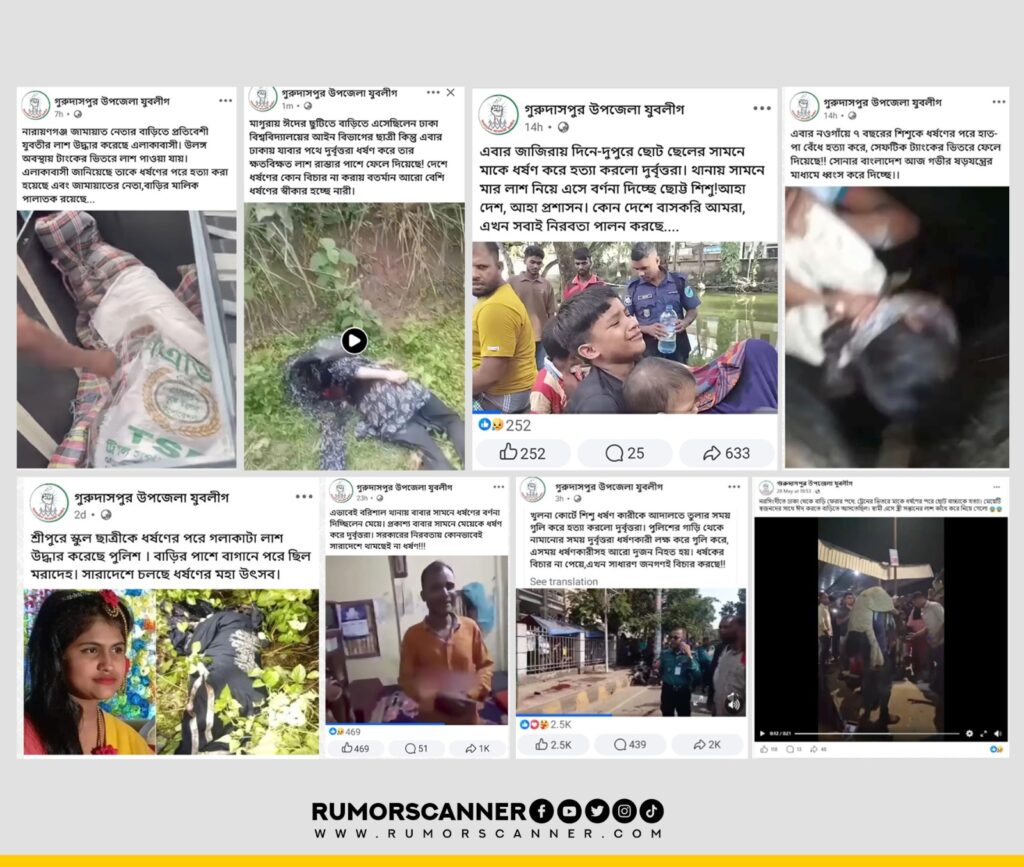
Furthermore, attempts to blame political opponents were also seen in a few instances of disinformation. For example, a video from the Philippines was circulated claiming that an expatriate’s child was abused in Jessore due to extortion by the BNP, and a video of a different incident was used to claim the recovery of a body at a Jamaat leader’s house in Narayanganj. Among other accounts and pages spreading disinformation, the presence of Jamaat-linked profiles was found in about 9.5 percent of cases, and profiles linked to BNP, Shibir, NCP, Islami Andolan, and Khelafat Majlish were found in about 5 percent each; however, the involvement of the Awami League-supporter network was present in the propagation of all the identified disinformation.
An analysis of information over the past three years surrounding the talked-about incidents of violence against women and children brings a clear reality to light—in Bangladesh, not only crime but post-crime disinformation has now turned into a parallel crisis. While the presence of disinformation was limited during the 2024 Jahangirnagar University rape incident, it rapidly took on a multidimensional form following the 2025 Magura and 2026 Pallabi incidents. In particular, victim-centric propaganda, politically motivated narratives, fake photos-videos, and the use of AI-generated content have increased alarmingly. The analysis further demonstrates that the spread of disinformation is not always directly related to the actual number of crimes; rather, the level of social uproar, political relevance, and online engagement of an incident makes the ground for generating disinformation even more fertile. The use of disinformation as a tool to construct political narratives and influence public opinion centering on high-profile crimes is also becoming increasingly visible. Consequently, the necessity of verifying the authenticity of information and preventing disinformation alongside demanding justice for sensitive incidents like violence against women and children has grown more than at any time in the past.
Methodology
In this study, the disinformation that spread surrounding the 2024 Jahangirnagar University rape case, the 2025 Magura child abuse and death, and the 2026 Pallabi child murder has been analyzed. For data, Rumor Scanner’s fact-check reports, information published by Ain o Salish Kendra (ASK), Bangladesh Mahila Parishad, and various media outlets have been utilized. The number, type, and propagation trends of disinformation identified before and after the talked-about incidents have been reviewed. However, since the analysis is based on the disinformation identified by Rumor Scanner, all disinformation may not be included herein. Additionally, the evaluation of political affiliation was conducted based on the public information of the respective accounts and pages.