

From ‘Hindu Persecution’ to ‘Muslim Eradication’: The Shared Pattern of Communal Propaganda in Bangladesh-India
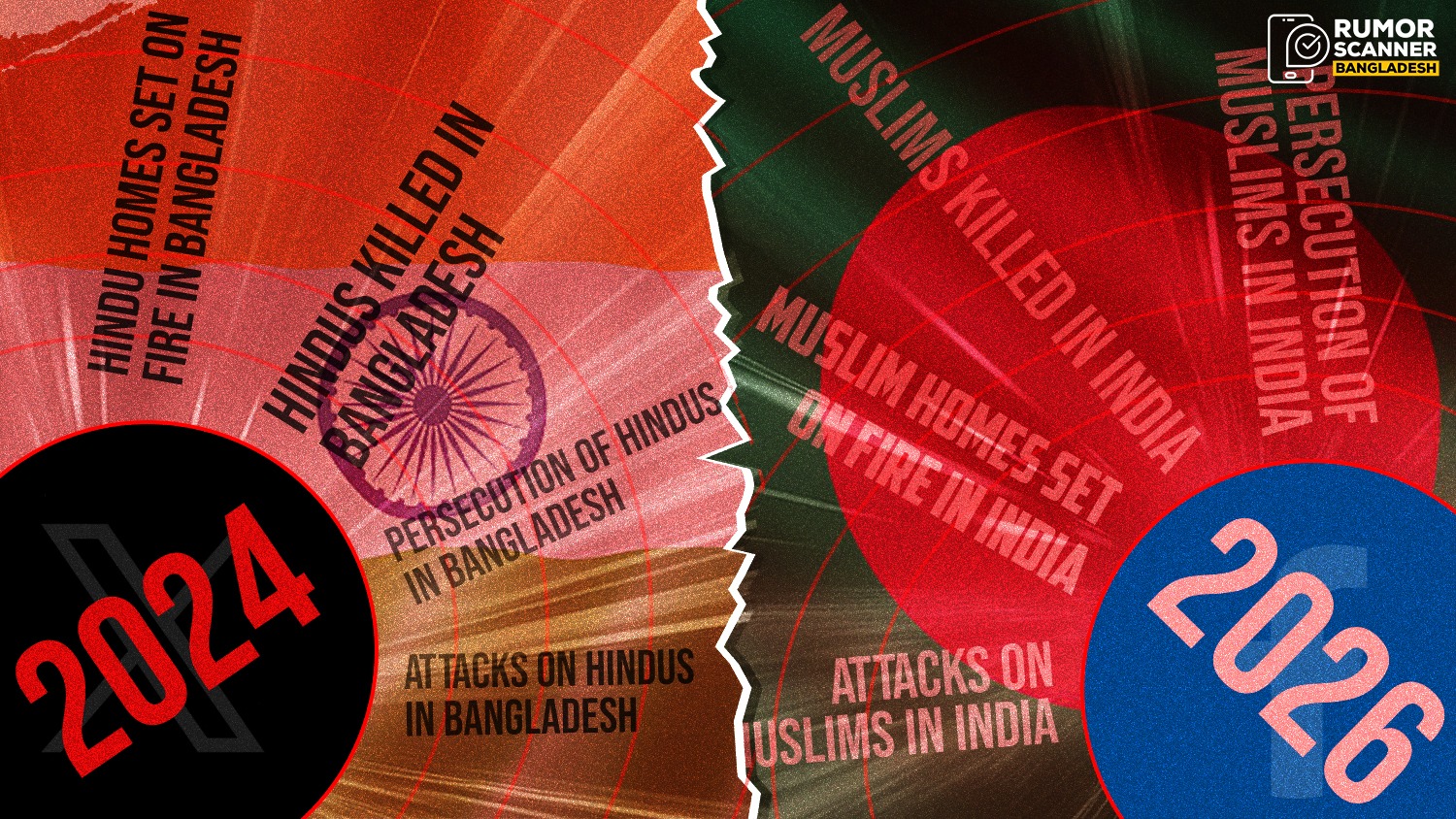
August 5, 2024. The Awami League government had just fallen. In the government-free days that followed, numerous incidents of political attacks, killings, vandalism, arson, and looting came to light across various parts of the country. Homes and establishments of different religious communities were also targeted. Seizing upon this situation, communal propaganda spread rapidly on X (formerly Twitter). At that time, Rumor Scanner identified several X accounts that were spinning and promoting various incidents in Bangladesh with a communal angle.
Nearly two years later, in May of this year, news of post-assembly election violence emerged from several states in India. Around these incidents, the spread of communal propaganda began once again. This time, however, the scenario is somewhat different. The primary platform for this propaganda is not X, but Facebook; and this time, Bangladeshi profiles are playing an active role. In the first 21 days of this month, nearly 80% of the communal propaganda identified by Rumor Scanner was spread from Bangladeshi accounts. This raises the question: in response to previous propaganda by Indians, have Bangladeshis now also stepped up to create a ‘counter-narrative’?
Political Instability to Communal Narrative: The 2024 X Trend
Following the fall of the Awami League government on August 5, 2024, a massive surge of communal propaganda flooded X, centering around the violence, attacks, and instability across various parts of Bangladesh. An investigation by the Rumor Scanner Investigation Unit identified at least 50 X accounts over a nine-day period (August 5 to 13), each containing at least one post that framed the situation in Bangladesh through a communal lens. Video footage was utilized in 80% of these identified cases; among these videos, nearly 30% were old clips from entirely different events prior to August 5, while the remaining videos captured actual incidents that occurred after the government’s fall but were falsely presented as evidence of communal persecution. Furthermore, approximately 72% of these identified disinformation-spreading accounts explicitly identified themselves as being based in India.
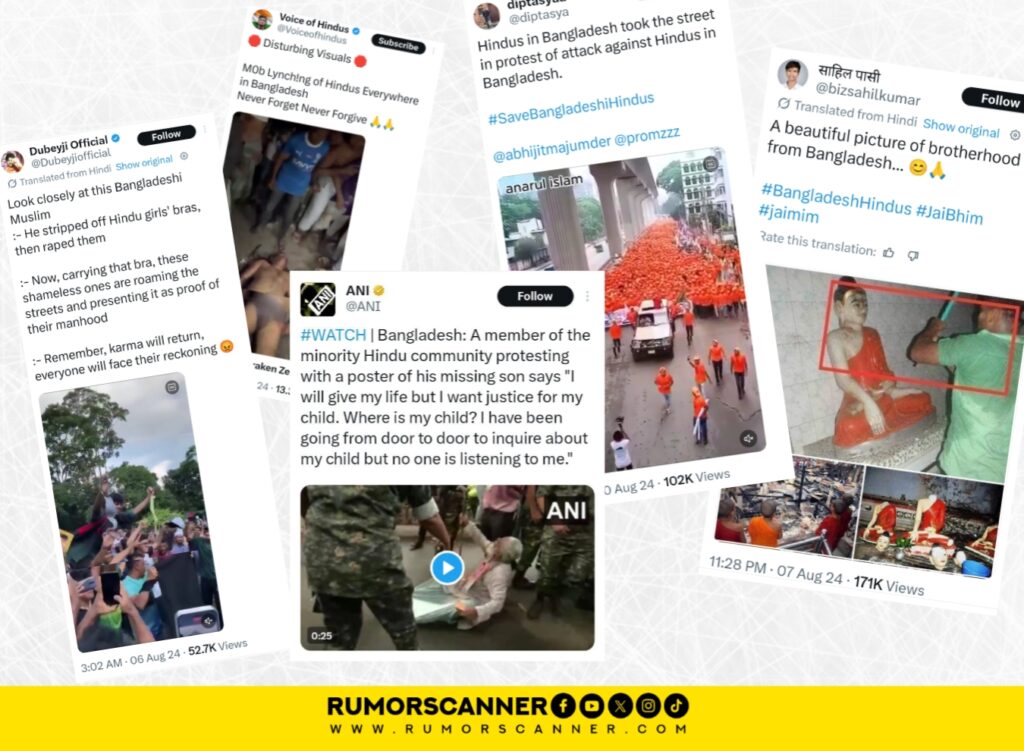
The investigation further reveals that many posts weaponized old, irrelevant images and videos from different countries, falsely claiming them to be evidence of the ‘persecution of Hindus in Bangladesh.’ In some instances, incidents of purely political violence were reframed as religious persecution, while in others, false identities were used to craft narratives targeting specific religious communities. Provocative language, such as ‘genocide’ or ‘systematic attacks,’ was also deployed in several posts. This misleading information wasn’t just limited to anonymous or troll accounts; there were documented instances of mainstream Indian media outlets, verified profiles, and well-known, politically active accounts spreading these fabrications. Ultimately, Rumor Scanner’s analysis indicates that these pieces of communal propaganda bore the hallmarks of a coordinated propaganda campaign.
Post-Assembly Election Violence and Disinformation from Bangladeshi Profiles
Post-assembly election violence across several states in India sparked a widespread surge of communal propaganda on social media throughout May. An analysis of fact-checks published by Rumor Scanner confirms that Bangladeshi profiles were linked to the spread of at least 28 pieces of identified disinformation regarding these events. Among these fabrications, 13 instances repurposed content from entirely unrelated past events to falsely claim they represented recent communal violence. Additionally, five pieces featured content originating from foreign countries, two weaponized footage or images from unrelated incidents within Bangladesh, and at least five pieces of content were found to involve entirely scripted or staged events.

Platform analysis reveals that Facebook was the primary medium for spreading this disinformation, with all 28 identified fabrications circulating on this Meta platform. Additionally, 11 of these contents were shared on Instagram, five on YouTube, two each on X and Threads, and one on TikTok. In at least three instances, these fake claims even managed to infiltrate mainstream Bangladeshi media.
The fact-checks show that in some cases, old videos of violence were circulated with claims of ‘attacks on Muslims after the election,’ while in others, footage of foreign incidents was passed off as the current situation in India. Most of these posts utilized religious identity and emotionally charged language in an attempt to spin the events into a communal narrative.
Bangladesh to India: Shared Tactics in Crisis-Driven Communal Propaganda
On August 6, 2024, an Indian X profile named “Akshit Singh” claimed in a post that over 10,000 Hindus had been killed by Bangladeshi militants. Fact-checking at the time revealed that no deaths had actually occurred due to communal attacks in Bangladesh. Nearly two years later, in May of this year, several Bangladeshi Facebook profiles and pages claimed that Hindutva terrorists had killed 487 Muslims within 72 hours during violence in India. This was also verified and found to be false; reports indicated that at least 13 people died in violent incidents between May 4 and 13, only one of whom was Muslim.
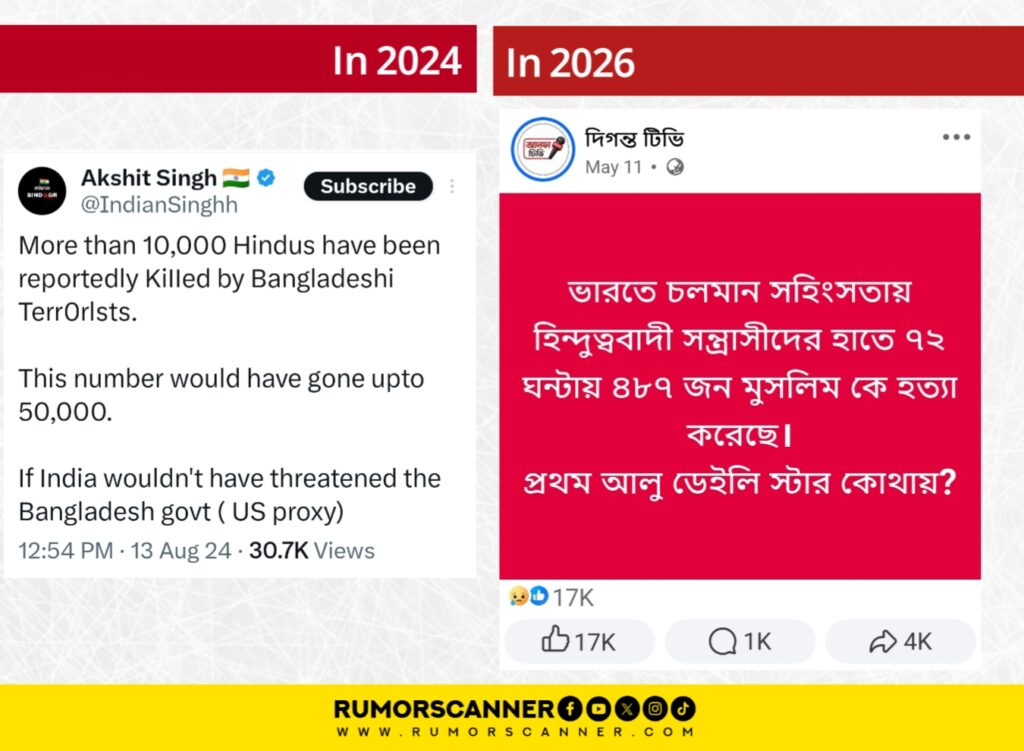
Although both claims circulated under different contexts, they share a striking similarity in how the disinformation was manufactured. In both instances, incidents of communal violence were wildly exaggerated to claim a massive number of casualties—on one hand, ‘10,000 Hindus killed’ in Bangladesh, and on the other, ‘487 Muslims killed in 72 hours’ in India. Subsequent fact-checking revealed that neither claim had any basis in reality. In essence, exaggerated and misleading data were fused with real events to target religious communities, provoking emotions and attempting to incite fear, anger, and communal tension.
Despite the differing political landscapes of the two countries, further parallels can be drawn between the disinformation campaigns of 2024 and 2026. In both cases, there was a deliberate effort to construct a communal narrative around actual violence or instability. Images and videos of political violence, vandalism, or clashes were repackaged and presented as definitive proof of religious minority persecution. The primary strategies deployed across both scenarios included utilizing old, foreign, or out-of-context content, attributing false identities, and employing emotionally manipulative language. A clear tendency to exploit online users’ emotions was also evident in both campaigns through the use of provocative buzzwords like ‘genocide’, ‘systematic attacks’, ‘Muslim eradication’, or ‘Hindu persecution’.
However, some differences exist in the nature of the campaigns and their choice of platforms. In the 2024 communal propaganda targeting Bangladesh, X was the primary platform, where evidence showed the involvement of verified accounts identifying as Indian, politically active profiles, and mainstream media outlets. Conversely, in the disinformation spread by Bangladeshi profiles regarding India’s post-election violence, Facebook-based network played the largest role. Additionally, the same narrative spread across Instagram, YouTube, Threads, and TikTok. This means that while the first case saw a heavier presence of a relatively influential, high-reach X network, the second case was characterized by a more prominent multi-platform social media campaign.
Both incidents demonstrate that tense situations, such as political crises or post-election violence, create fertile ground for the spread of communal propaganda online. By fusing distorted or fake content with real events, narratives are constructed that can rapidly induce fear, anger, or a desire for revenge in the public mind. At the same time, this trend highlights the reality of cross-border digital propaganda, where the political or social crisis of one country becomes raw material for communal campaigns by users in another.
The Cycle of Counter-Propaganda in the Bangladesh-India Context
Analysts view the recent trends in communal propaganda between Bangladesh and India primarily as a continuation of a counter-propaganda cycle. Md. Sayeed Al-Zaman, an Assistant Professor in the Department of Journalism and Media Studies at Jahangirnagar University, directly characterizes this phenomenon as ‘digital retaliation’. Speaking to Rumor Scanner, he noted, “Users from one country are weaponizing events in another as raw material for political or communal propaganda.” A matching observation was shared by Indian journalist Arka Bhaduri, who posits that there is no fundamental difference between the communal propaganda spread by Indian X accounts regarding Bangladesh in 2024 and the disinformation spread by Bangladeshi profiles regarding Indian violence in 2026; rather, it is a repetition of the exact same strategy. He believes that in both nations, half-truths, distorted information, and outright fabrications are constructed upon a foundation of real crises and then exploited for political mileage.
Both perspectives highlight how communal narratives are built by fusing real events with old videos, images from foreign countries, or entirely out-of-context content. In the words of Sayeed Al-Zaman, the context of old photos or videos is altered to give them a new, communal meaning, thereby engineering an emotionally charged framework of ‘victim versus oppressor.’ He added, “Even if it is an old video or an out-of-context photo, it appears believable if it aligns with the existing narrative of one’s peer group or community.” Similarly, Arka Bhaduri believes that the ‘modus operandi’ of Islamist forces in Bangladesh and Hindutva forces in India is nearly identical. “We observed a strange unity between the two countries when it comes to spreading fake news,” he remarked, implying that organized politics of hatred, division, and communal polarization are being cultivated in both nations.
Both analysts also placed significant emphasis on the combined impact of algorithms, political polarization, and online emotions. Sayeed Al-Zaman observed, “Human emotion and political polarization act as the primary drivers, while algorithms multiply that force exponentially.” He explained that because religious or communally charged content generates higher engagement, social media algorithms actively push them further. Arka Bhaduri shared a matching sentiment, telling Rumor Scanner, “A market value has been created for hatred, and because people react more to hateful content, algorithms exploit that emotion.” According to him, a monstrous cultivation of hatred is underway across the subcontinent, continuously deepening the Hindu-Muslim divide.
The two analysts from both sides of the border warn that this trend of retaliatory disinformation on social media, targeting events in a neighboring country, is extremely dangerous for the future. Sayeed Al-Zaman cautioned, “Online rumors are not confined to the virtual world; they can trigger bloody, real-world clashes at any moment.” He further noted that such disinformation creates long-term distrust and bitterness between the people of both nations. Arka Bhaduri also called it ‘highly alarming,’ stating, “India and Bangladesh seem to have entered a long, dark tunnel where the practice of mutual hatred is steadily growing.” Their observations make it clear that digital disinformation is no longer just an online issue; it has evolved into a massive challenge for social coexistence, communal relations, and the broader information ecosystem in South Asia.