

Parliamentary Elections: Key Disinformation Threats to Watch

The electoral process is not just a matter of counting votes—it fundamentally depends on the informed and conscious participation of the people. This is not a new idea. Yet in recent years, elections around the world have shown how quickly false and misleading information can spread through social media, online platforms, and sometimes even traditional media. Such disinformation does more than confuse voters; it can undermine trust in the democratic process itself.
In Bangladesh and other South Asian countries, various forms of misleading information often circulate during elections. Sometimes these are deployed explicitly to favor or oppose certain parties, while at other times they are strategically designed to shape public opinion about electoral behavior.
Bangladesh is gearing up for the 13th National Parliament elections next month, on February 12. Candidates are already on the ground, campaigning door to door. This should be a time of festive electoral enthusiasm. Yet where disinformation has become a constant companion, it can disrupt election activities and create unexpected negative situations at the polls, potentially altering the outcome at any moment.
This article aims to identify the likely types of disinformation during election periods and provide guidance on how to respond swiftly and effectively.
The Rise of Photocards as a Weapon of Disinformation
This time, the number of candidates is higher than ever, and the use of digital and online platforms in campaigning has increased accordingly. Rumor Scanner has been working dedicatedly on this election for more than a year. What we have observed is that election-related disinformation has evolved in form over time.
For example, in a study published last June, Rumor Scanner found that during the first five months of the year, the majority of political disinformation was spread through fake and edited statements attributed to political parties and senior government officials. A major vehicle for spreading this disinformation has been fake photocards designed to resemble legitimate media content.
At present, these fake photocards have become one of the most dangerous weapons of disinformation in Bangladesh’s information ecosystem.
A fake photocard is an image or graphic that uses the logo and visual style of well-known media outlets. It looks exactly like a genuine news card, but the information it contains is entirely fabricated or distorted.
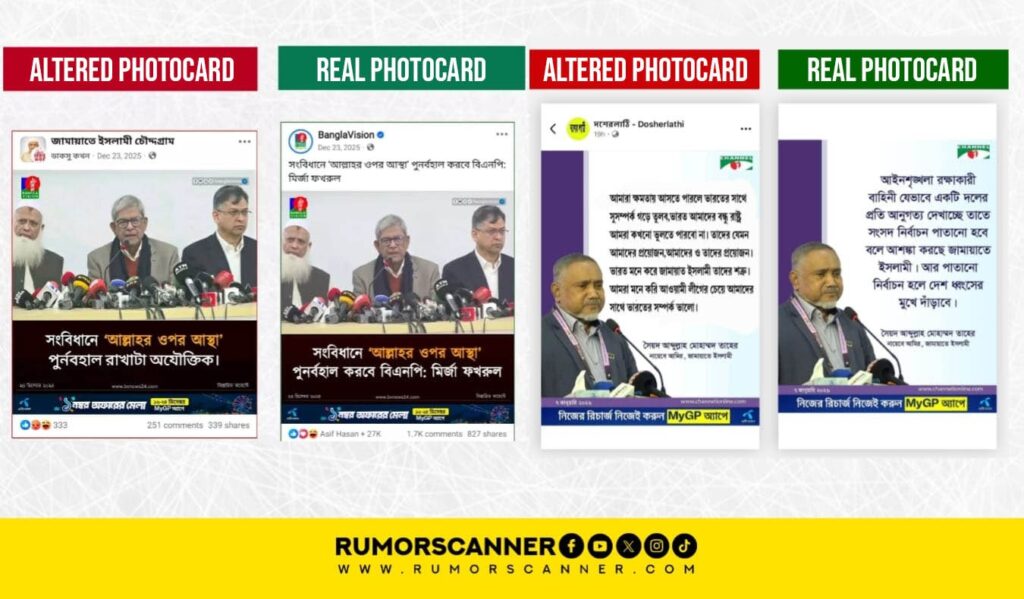
Fake photocards are highly effective in spreading disinformation because people naturally trust the media. Seeing a familiar logo often leads them to assume the news is true, and many share it without verification, allowing it to reach thousands within hours. As a result, even aware citizens and those at the margins of society can be misled. Last December, some fake photocards were even taken seriously, prompting a responsible politician to issue a statement based on them.
The severity of this problem becomes evident through statistics: in 2025, 744 false claims were circulated in 687 incidents involving 75 domestic and international media outlets, using fake photocards that mimicked logos, headlines, and media names. On average, more than two false claims per day tried to mislead people by exploiting media credibility. This is an increase from 505 incidents in 2024. In just the first 2 days of this month, 199 disinformation appeared in 170 incidents involving 32 media outlets, with nearly 92% of these fake photocards related to political content.
There are several simple but effective ways to identify fake photocards. First, check the language and spelling carefully, as many contain irrelevant fonts, spelling mistakes, or unnatural sentence structures.
Second, compare the logo and design with the official media outlet’s Facebook page or website, since fake photocards often have discrepancies in color, layout, or branding.
Third, verify the image source using Google Reverse Image Search or other image verification tools, and cross-check the publication date, context, and caption, as old images are often circulated as new events.
Finally, watch for emotionally charged language or content targeting specific groups, which is often a sign of fabricated photocards designed to provoke reactions. Following these steps can help readers protect themselves from disinformation and avoid being misled by fabricated content.
Concerns Over AI Deepfakes Fueled by Advanced Technology
Before the 12th National Parliament elections held in Bangladesh on January 7, 2024, three videos circulated online claiming to show statements by Harun Or Rashid, then head of the Dhaka Metropolitan Police (DMP) Detective Branch (DB), independent candidate Beauty Begum from Bogura-2, and independent candidate Nahid Nigar from Gaibandha-1. In Harun Or Rashid’s video, he appeared to urge people not to vote at the polling stations, while the videos of Beauty Begum and Nahid Nigar suggested that they were withdrawing from the election. However, all three videos were created using deepfake technology. In reality, none of these individuals ever recorded any statements conveying these messages.
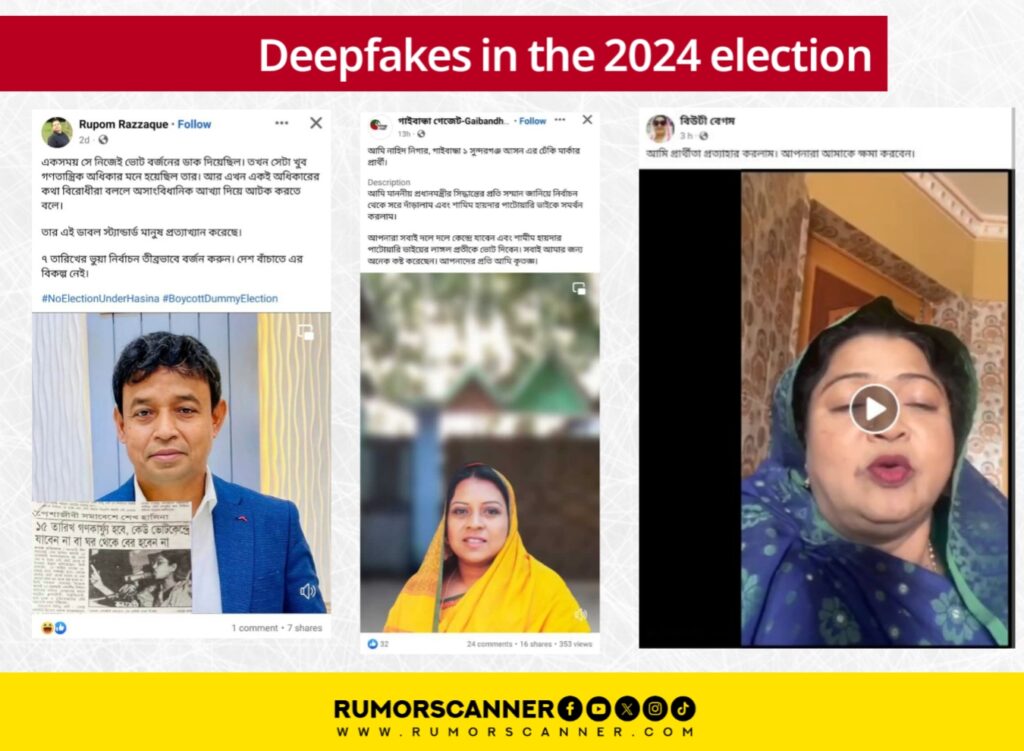
A deepfake is a fake video, audio, or image created using artificial intelligence, where someone is shown saying or doing something they never actually said or did.
Deepfakes primarily rely on deep learning and machine learning technologies, often using still images of a person. In many cases, elements from old videos are also incorporated. Today, this branch of artificial intelligence has become a powerful tool for spreading misinformation. During the 2024 elections, the use of deepfakes was limited, but it still caused significant harm to the candidates involved. Two years later, the situation has become far more alarming.
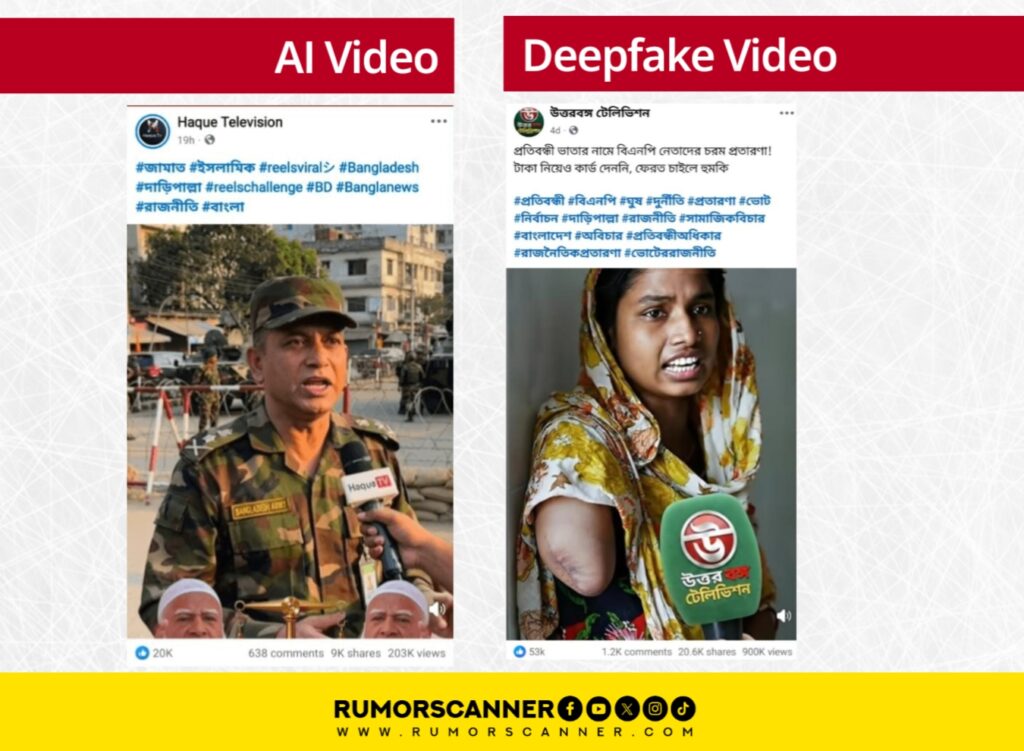
Last year, Rumor Scanner identified a total of 606 misinformation, including 86 deepfake videos, highlighting the use of AI technology. This represents an increase of approximately 409% compared to 2024. In just the first 26 days of this month, 73 AI-based content items, including 10 deepfake videos, were detected, nearly all of which were politically focused.
Detecting AI or deepfake content requires careful attention to several key factors. First, it is important to observe whether facial expressions and lip movements match the voice, as many AI videos have inaccurate lip-syncing. Unnatural blinking, fixed or wandering gaze, or distortions in facial structure can also be signs, as can inconsistencies between lighting and shadows on the face. In terms of audio, robotic tones, unusual pronunciation, or lack of emotional expression can indicate a deepfake. Second, AI-based tools can detect pixel-level inconsistencies, micro-expressions, and mismatches in lighting and shadows in images or videos. Audio content can also be analyzed for irregularities in voice frequency patterns or pronunciation, while machine learning models can reveal which parts have been artificially altered or faked. Third, and most importantly, verifying the source of the content is crucial. In Bangladesh, several Facebook pages and TikTok accounts regularly publish AI content. Although they claim to share such political content for entertainment purposes, it often spreads to other accounts and pages without any disclaimers, clearly misleading netizens. Therefore, if there is suspicion that a piece of content is AI-generated, its source must be carefully traced.
Women Candidates: A Separate Target of Disinformation
At the beginning of last year, there was little disinformation targeting women politicians. However, by the end of the year, fake content began to be spread specifically in the names of potential female candidates. A study by Rumor Scanner in October showed that during the first nine months of the year, at least seven political parties and 25 of their female leaders were involved in at least 237 incidents of disinformation. The majority of this content targeted young women politicians who are participating in the current electoral process. According to the Election Commission, there are 76 female candidates this time. The National Citizens’ Party (NCP) had initially nominated Dr. Mahmuda Alam Mitu, the central joint secretary, for the Jhalokathi-1 seat. After the NCP formed an alliance with Jamaat-e-Islami and agreed on seat distribution, Mitu withdrew her nomination in favor of the Jamaat candidate. Even before this, Rumor Scanner had identified at least 13 instances of disinformation targeting her since November, including the use of objectionable images and AI-generated content.
In December, Dr. Tasnim Jara, the senior joint secretary of the National Citizens’ Party (NCP), resigned from the party. She is contesting the election from the Dhaka-9 seat. Although she was initially the party’s candidate, she is now running as an independent. Before her resignation, Rumor Scanner had identified at least 20 instances of disinformation involving her, and since her resignation, at least 9 more have been recorded.
Similarly, Barrister Rumeen Farhana, former co-secretary for international affairs of BNP’s National Executive Committee, had sought the party nomination to contest from Brahmanbaria-2. However, following a seat-sharing agreement within the alliance, another candidate received the nomination, and Farhana is now running as an independent. This led to her expulsion from the party. Prior to her expulsion, Rumor Scanner identified at least 14 incidents of disinformation targeting her, and since then, at least 3 additional cases have been documented.
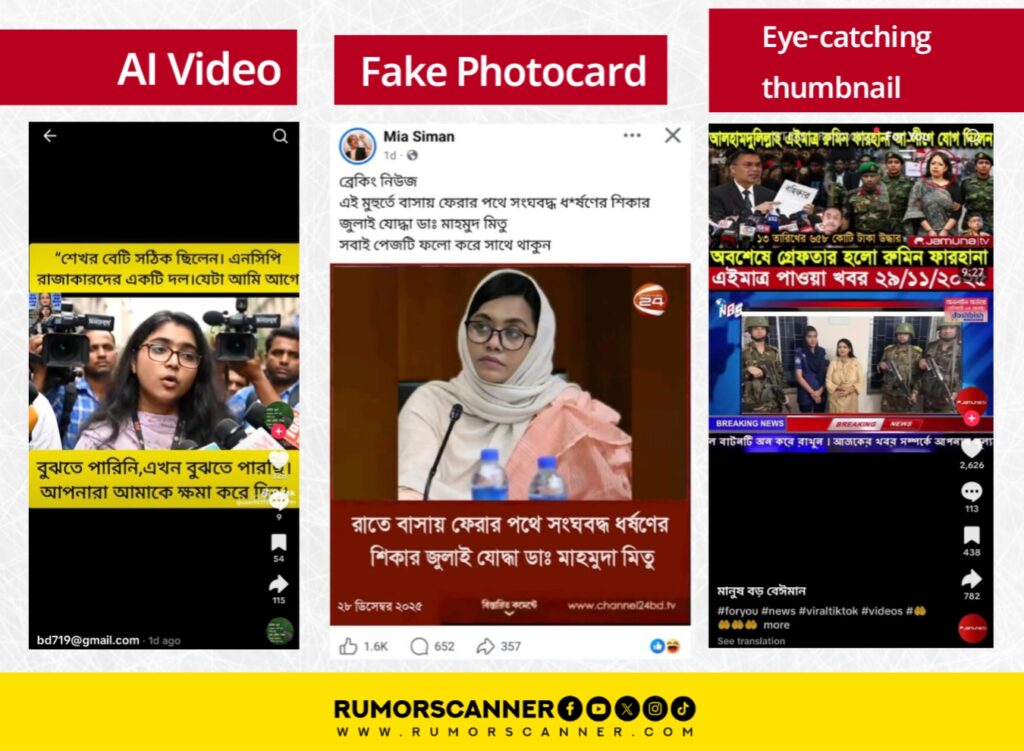
Women’s empowerment in Bangladeshi politics has always been a topic of discussion. In this context, targeted disinformation is mentally exhausting female politicians and, in many cases, threatening their participation in the political arena.
The first step in countering the flow of disinformation targeting active women candidates is to raise awareness and accelerate the decision-making process. Since women have become easy targets for AI-generated content and fake photocards, they can use their social media platforms to publicly clarify when such content is false. Additionally, the media outlets whose logos and formats are mimicked in fake photocards can issue posts to confirm that the content is fabricated. These two measures have proven effective, with Rumor Scanner finding evidence that they help stop the spread of disinformation in many cases. Immediate legal action against those spreading false content can also serve as a deterrent. Although the lengthy legal process discourages some from pursuing this path, Rumor Scanner advises maintaining faith in legal measures as a vital tool against disinformation.
The Trap of Communal Narratives
Another worrying trend that has emerged recently is communal propaganda. In Bangladesh, we have consistently observed that the volume of such propaganda rises whenever an important event or issue is at the forefront. Content is often circulated claiming the possibility of communal violence even when there is no actual connection to communal issues. Much of this propaganda originates from various “ex accounts” in India and, in some cases, from Indian media outlets.
In 2025, Rumor Scanner found evidence of at least 155 instances of disinformation about Bangladesh on Indian media and social platforms, roughly 5% higher than the previous year. These figures not only indicate the spread of disinformation but also highlight a growing trend. More concerning is the active role of mainstream Indian media in spreading such content. Last year, 73 Indian media outlets published a total of 140 reports across 38 incidents containing false or misleading information involving Bangladesh. Nearly 58% of these identified falsehoods were related to communal incidents, and the proportion is expected to rise further as elections approach, raising significant concerns.
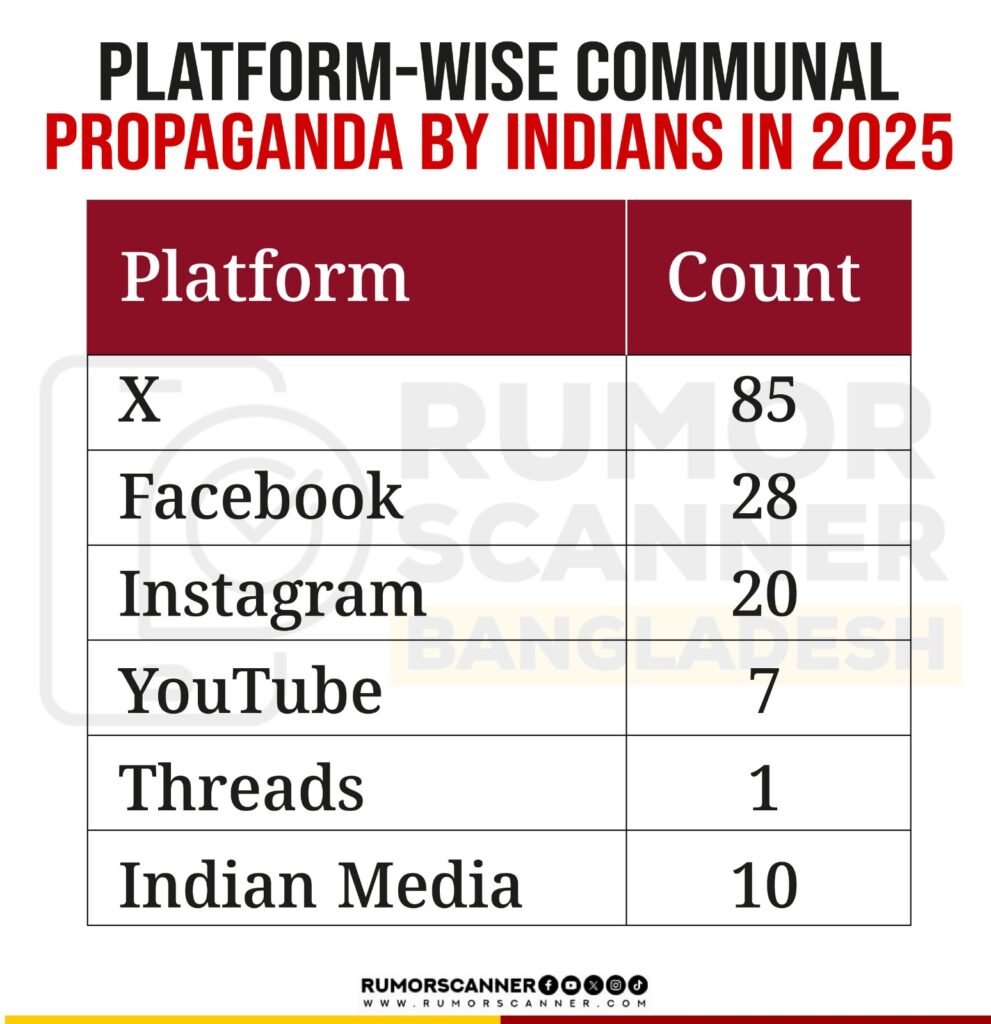
In the first 26 days of this month, Rumor Scanner identified 28 instances of communal disinformation, nearly 79% of which originated from Indian sources.
The first step for ordinary citizens in countering communal propaganda is to cultivate the habit of verifying information instead of taking every report at face value. Just because a member of a minority group is a victim in an incident does not automatically make it communal; it is important to distinguish between ordinary crime and hate crime. Often, before investigations conclude—or even when no communal evidence exists—events are falsely portrayed as communal, particularly by extremist accounts and some Indian media outlets that deliberately distort incidents in Bangladesh. Accidents, personal disputes, suicides, or ordinary murders are sometimes falsely labeled as communal, spreading fear, hatred, and division in society.
As responsible citizens, we should verify the sources of information, consult multiple reliable outlets, try to understand the motives, and avoid blindly accepting any narrative. For an incident to be truly communal, there must be a clear communal intent behind it.