

Mapping Disinformation: Data Insights from Election Day
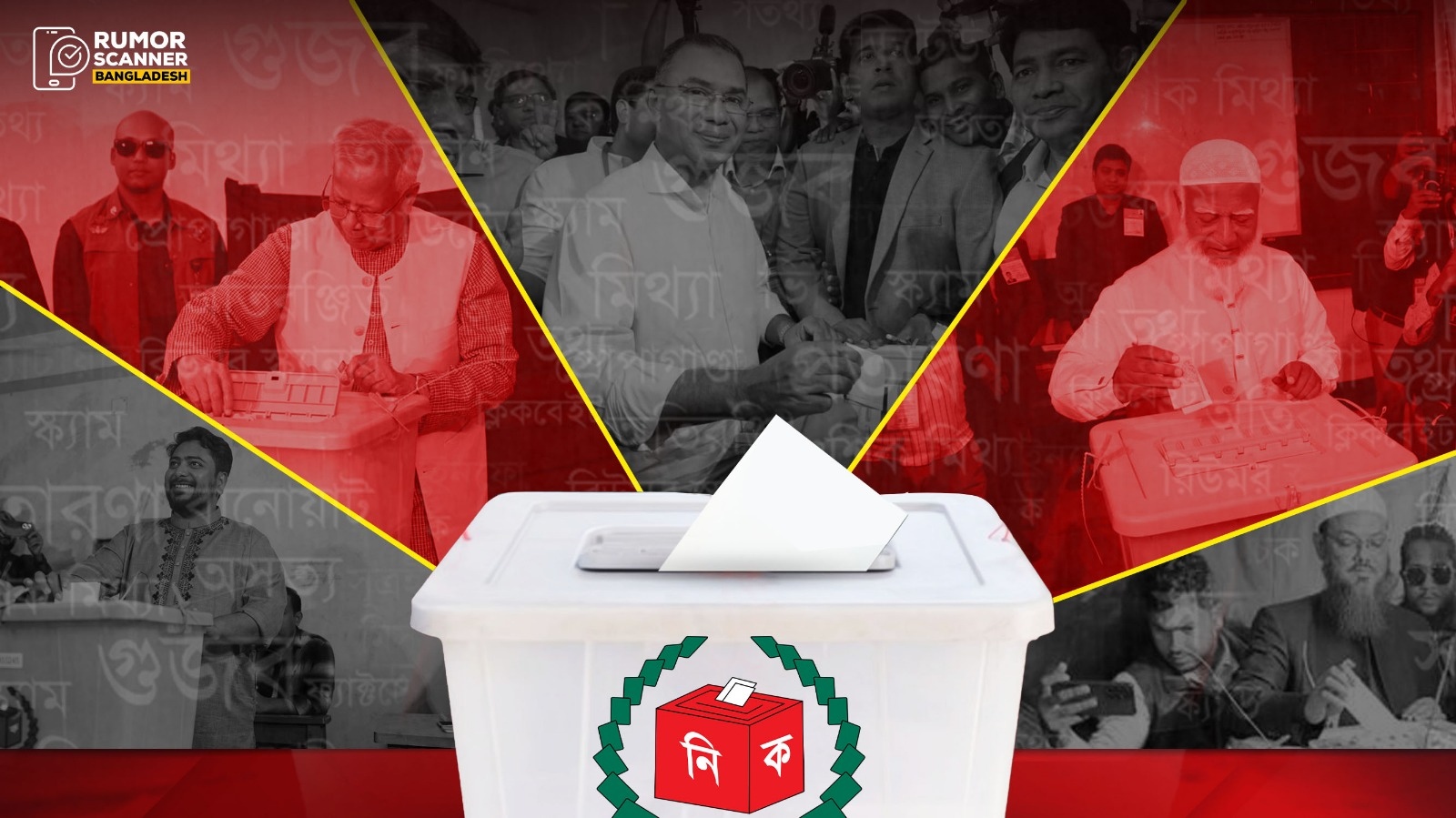
- 104 Pieces of disinformation Identified on Election Day.
- A total of 1,024 instances of disinformation have been detected surrounding this election so far.
- On election day, the highest volume of disinformation targeted the BNP and Tarique Rahman.
- Disinformation about 18 candidates withdrawing from the race were circulated.
- Fabricated photo cards were widely used as tools of disinformation.
- The Army and Police remained consistent targets of disinformation campaigns.
At Savar Bus Stand, Suruj Ali, a garment factory supervisor, waited anxiously with his family. “I want to go home to cast my vote, but I can’t find a bus,” he said. “Even after agreeing to pay double fare, there’s no seat available.” Later, he called to say that, unable to secure a bus ticket, he had begun his journey home in stages by auto-rickshaw.
Reports like this, published in a national daily ahead of the National Parliament election and referendum, captured a nation poised in anticipation—almost like waiting for a festival. The countdown had begun two months earlier, when the election schedule was announced. What followed were days packed with nomination submissions, scrutiny, withdrawals, campaigning, alliance-building and breakups—politics in full motion.
Finally, the long-awaited day arrived: Thursday, 12 February. Through the 13th parliamentary election, citizens across the country exercised their right to vote, hoping to steer the nation forward on its democratic path.
But elections are never just about ballots and ballot boxes. In Bangladesh’s political landscape, disinformation has become a quiet yet constant companion to electoral contests. Rumor Scanner closely monitored the flow of disinformation on election day. Its analysis found that 104 pieces of disinformation were identified on that single day alone.
Overall, from January 2025 to 13 February 2026, at least 1,024 instances of election-related disinformation have been detected so far.
Disinformation Fueled Panic by Spreading ‘Night Voting’ Rumors
A video went viral on the eve of the election with the caption: “Votes meant for the day are being cast at night.” The post sharply criticized the integrity of the voting process. However, upon verification, Rumor Scanner found that the footage was actually from a 2024 Upazila Parishad election, showing incidents of ballot fraud from that earlier contest — not from the current national election.
In another widely circulated clip, ballot papers were seen being stamped, accompanied by the same claim that voting was taking place overnight. After investigation, Rumor Scanner confirmed that the footage was AI-generated. The original creator of the manipulated video was also identified during the verification process.
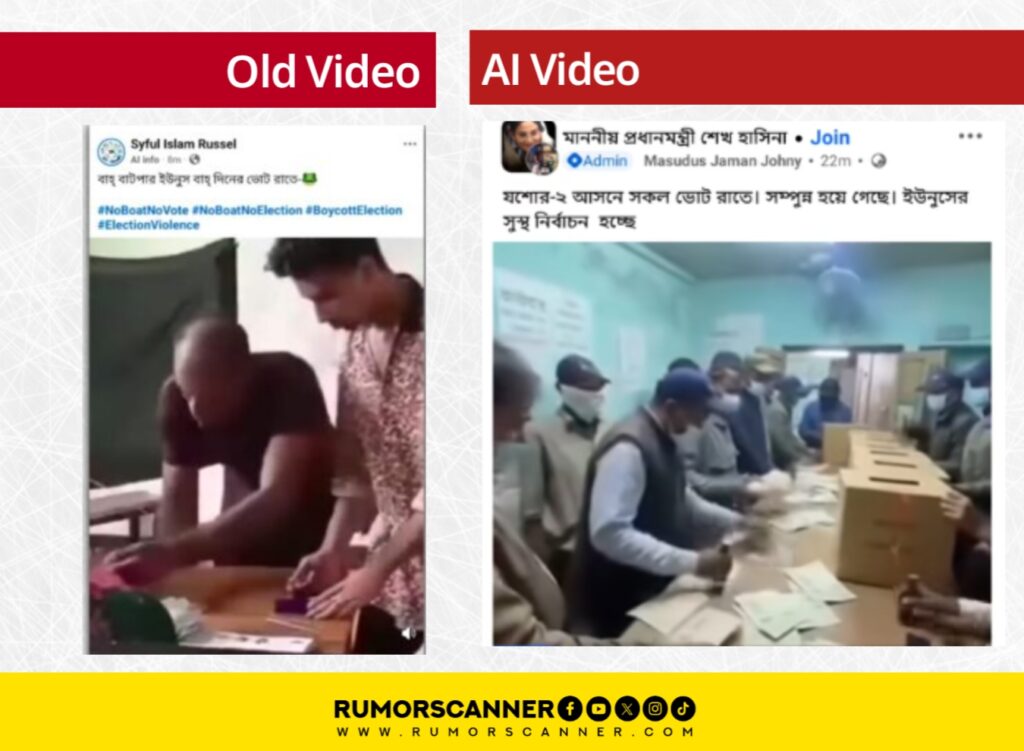
The term “night voting” entered Bangladesh’s electoral vocabulary in 2018. During that year’s election, allegations emerged from multiple polling stations claiming that ballot boxes had been filled the night before voting day. Several media outlets, including BBC Bangla, found evidence supporting those claims at the time. The term resurfaced again during the 2024 election, remaining politically charged and widely debated.
This year, purveyors of disinformation strategically weaponized that very phrase. At least eight videos were circulated on the night before the election, claiming that ballot papers were being stamped overnight. However, verification revealed that the clips were either old footage, AI-generated content, or videos showing the legitimate stamping of postal ballots — not evidence of clandestine nighttime voting.
Polling Station Chaos vs. Drill Footage
Although the 12 February election did not witness large-scale bloodshed or widespread violence, incidents of clashes and counter-clashes were reported in several parts of the country.
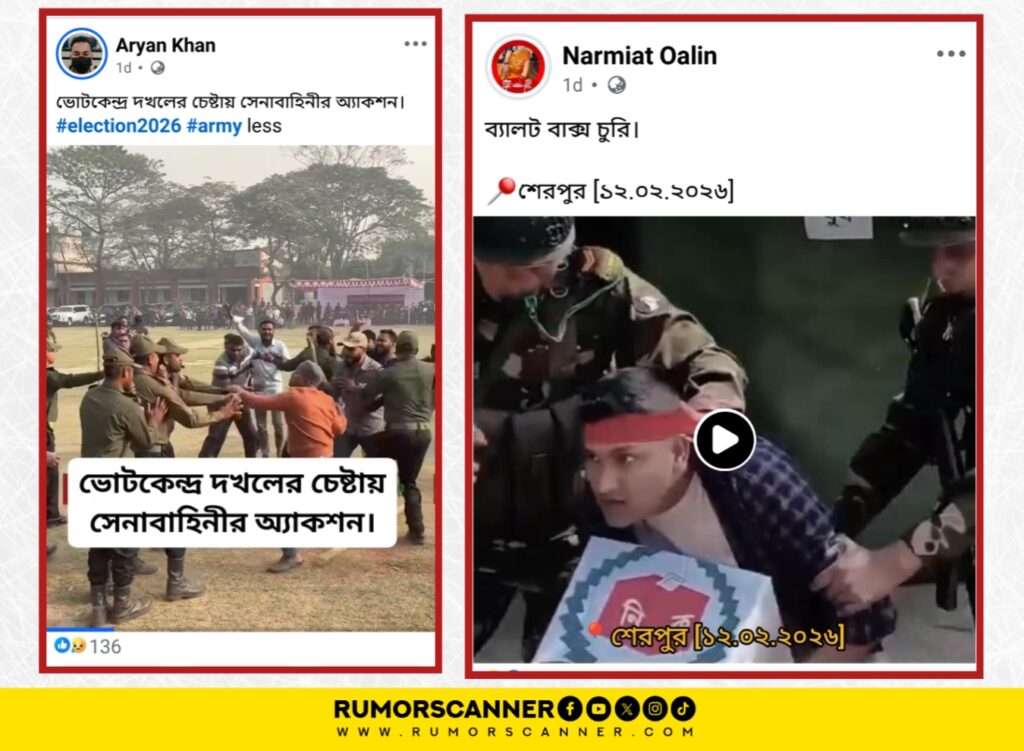
Amid this backdrop, at least four videos were circulated online claiming to show polling stations being seized and ballot boxes being stolen. The posts suggested that chaotic takeovers were unfolding on election day.
However, investigation revealed that the footage was not from 12 February at all. In fact, the videos were recorded earlier and primarily showed training drills conducted by the Army and other security forces ahead of the election. These routine exercises were falsely reframed as evidence of vote rigging and polling station capture.
In another instance, a video was circulated claiming to show a cocktail explosion and clashes during an alleged attempt to seize a polling station in Lakshmipur-1 constituency. However, Rumor Scanner’s verification found that the footage was actually from 2021, not from the recent election.
Similarly, another video alleged that in Jamalpur, members of Jamaat-e-Islami vandalized and looted homes of minority communities under police protection because they did not go to vote. Yet fact-checking revealed that the video had already been available online at least a week before the election, proving it was not related to voting day events.
Deepfake Videos Claiming Candidate Withdrawals
It is common in elections for candidates to withdraw for various reasons. However, when claims circulate that a candidate has withdrawn without their knowledge or consent, it becomes unmistakably disinformation—and it can potentially influence voter behavior and election outcomes.
In this election, 18 candidates were targeted by such false narratives. Among them were four from BNP, two from Jamaat-e-Islami, two from Islami Andolan Bangladesh, and one from the National Citizens Party (NCP). The largest share, 10 names, belonged to independent candidates.
These claims were spread through Facebook posts, fake media photocards, and AI-generated deepfake videos, falsely asserting that these candidates had stepped down from the race.
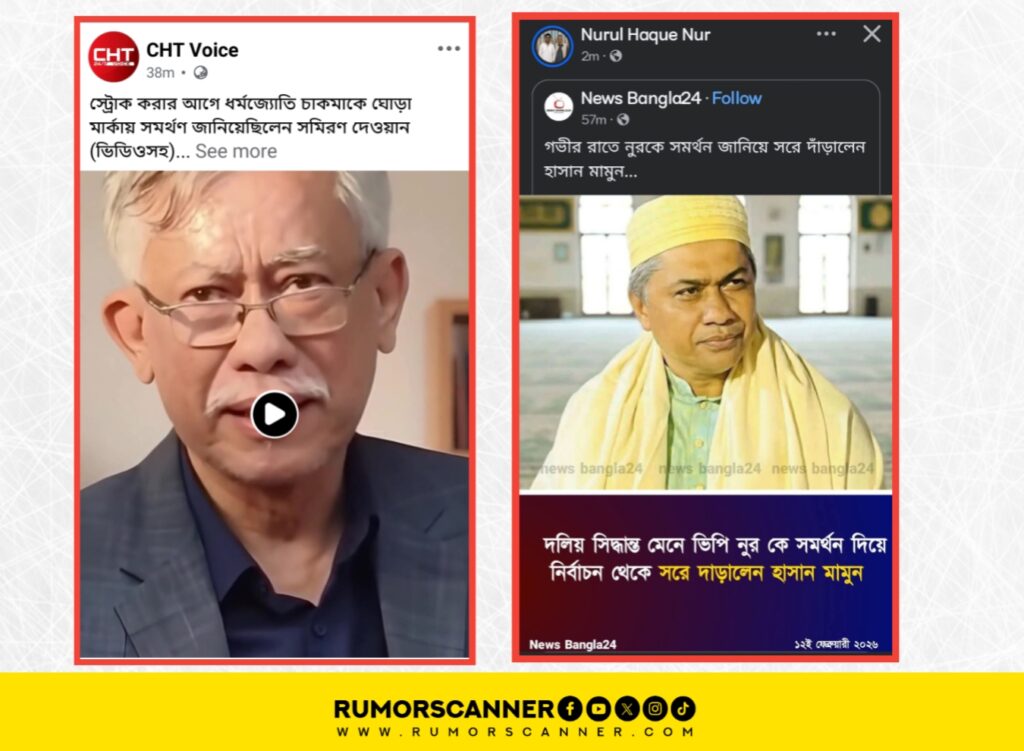
During voting, a false claim circulated that Hasan Mamun, an independent candidate and expelled BNP leader from Patuakhali-3 constituency, had withdrawn from the election.
Rumor Scanner verified that this disinformation was being actively promoted to benefit Nurul Haque Nur, the BNP-backed candidate and president of the Gana Odhikar Parishad, as seen in posts on his Facebook page.
45 Candidates Targeted by disinformation on Election Day
On election day, 45 parliamentary candidates were targeted by various types of disinformation, resulting in a total of 59 recorded incidents. Male candidates were affected the most, with 43 individuals experiencing 55 false claims, including Tarique Rahman from Dhaka-17 and Bogra-6, who faced the highest number at 12 incidents. Among female candidates, 2 were impacted by 4 incidents, with Shama Obayed Islam, the BNP candidate from Faridpur-2, being the most targeted with 3 false claims.
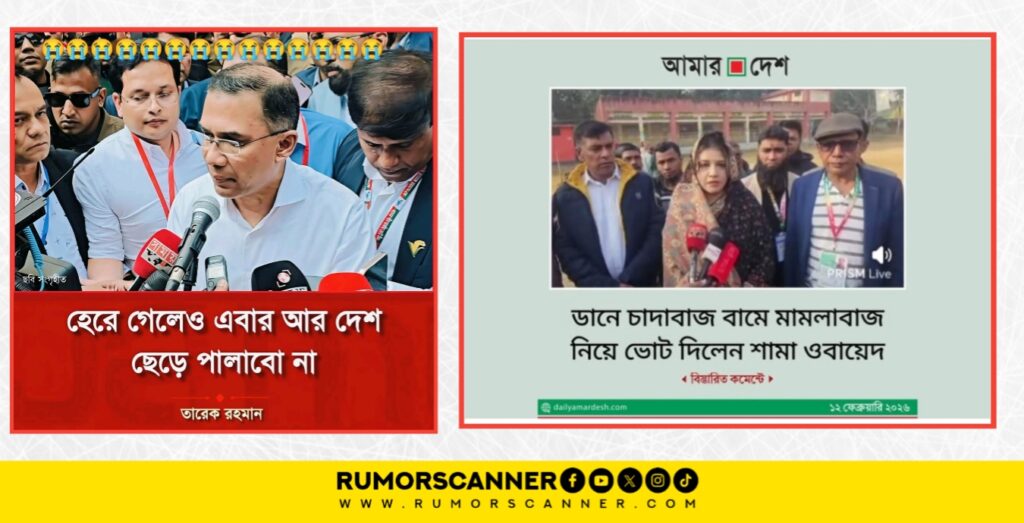
During the election season, photo cards were the most widely used medium, with 39 instances recorded. These easily created confusion among voters. Other types of disinformation included AI deepfakes (7 instances), fabricated or edited statements (18), claims related to electoral violence (7), old photos or videos (12), and rehearsal footage (4).
BNP and Tarique Rahman Targeted Throughout the Day
On election day, the Bangladesh Nationalist Party (BNP) emerged as the most targeted party, with 52 instances of disinformation, 88% of which were negative. These false claims focused on 14 parliamentary candidates, generating 28 incidents. The party chairman, Tarique Rahman, faced the highest number of attacks, with 12 incidents, 92% negative. Most of this disinformation was spread through photo cards (26 instances) and fabricated/edited statements (8 instances), while 3 pieces of AI-generated content were also recorded.
The Bangladesh Jamaat-e-Islami was targeted with 21 instances, 71% negative, affecting 8 candidates—each (Dr. Sultan Ahmed, Rezaul Karim, Sultan Mahmud Zakaria, Delowar Hossain, Matiur Rahman, Md. Mizanur Rahman, Maulana Abu Taleb, and Abdullah Al Faruq) facing one incident each. Photo cards remained the primary medium (11 instances), while one AI-generated content piece was positive in nature.
Meanwhile, the National Citizen Party (NCP) was involved in 10 disinformation incidents, 70% negative, affecting 5 candidates, with Sargis Alam targeted twice. For NCP, all methods—including fake/edited statements, photo cards, and AI-generated content—were used.
Rumors About Army Mutiny and Dhaka Police Commissioner Missing Voting
On the night before the election, a Facebook post claimed that there was turmoil at the Army Headquarters and that a section of the military had mutinied. The post received over 5,000 engagements and was widely shared. However, the Inter-Services Public Relations (ISPR) told Rumor Scanner that no such incident occurred.
In another widely circulated video, it was claimed that SM Sajjat Ali, Commissioner of Dhaka Metropolitan Police alleged someone else cast his vote. Investigation revealed that the video intentionally misled viewers by removing context. In reality, while speaking to the media, the Commissioner was recounting a memory from the 2018 election, explaining that at that time he learned someone else had cast his vote. The misleading video cut out the 2018 context, creating false impressions about the current election.
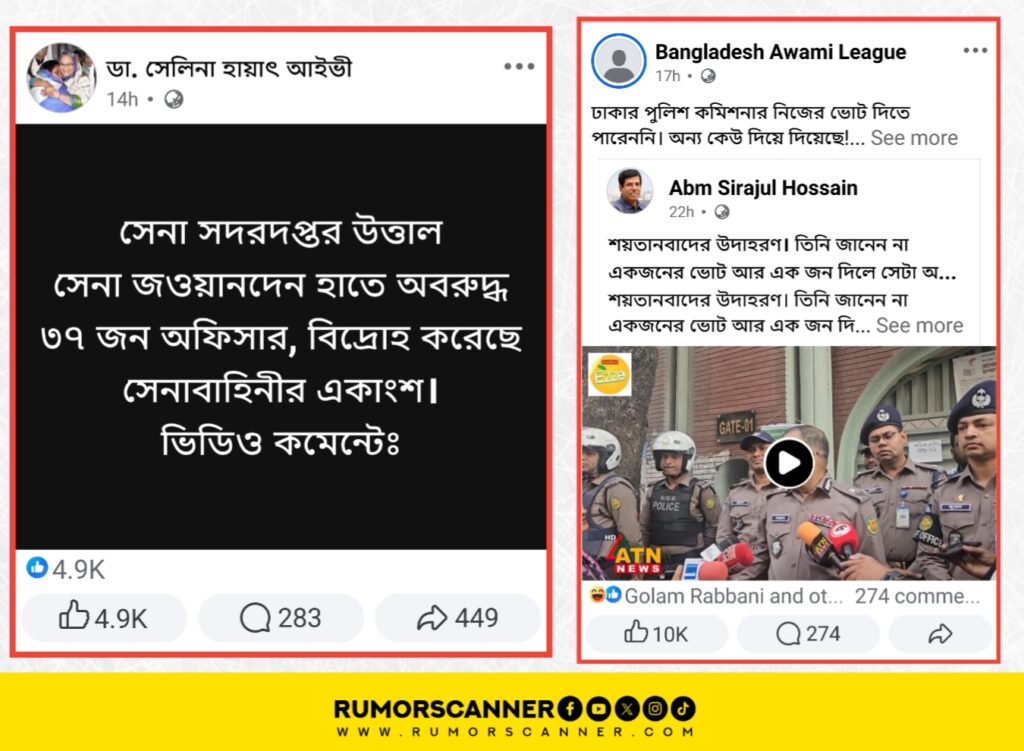
Analysis of election-day disinformation shows that the Bangladesh Army was the most targeted, with 12 false claims circulating. Army Chief General Wakar-uz-Zaman was specifically mentioned in 2 of these incidents.
In addition, 4 pieces of disinformation targeted the Bangladesh Police, and 1 incident involved Sheikh Sajjat Ali.