

Battling Disinformation: 21 Million Views for Rumor Scanner’s Election Coverage

Elections remain a cornerstone of Bangladeshi politics. Seven months after the fall of the Awami League government in 2024, the nation’s focus shifted toward the timeline for the 13th Parliamentary Election. Following an 18-month tenure by the interim government, the election was finally held on February 12, featuring 50 participating parties and a voter turnout exceeding 59%. While political parties spent over a year and a half preparing for the polls, Rumor Scanner, the country’s largest fact-checking organization, was equally prepared. Beginning its intensive monitoring in January 2025, the institution identified over 1,000 instances of disinformation. Through its website and social media, Rumor Scanner’s coverage comprising three statistical reports, three fact-stories, and four fact-files—garnered a massive 21.2 million views within just three days of the election.
On January 8, 2025, Rumor Scanner officially launched its mission to track disinformation surrounding the 13th National Election. The digital landscape began quietly, with only 39 cases identified through May. However, by mid-year, a statistical report revealed a troubling trend: the majority of these fabrications were targeting high-ranking officials and political leaders through doctored quotes and manipulated statements. Between June and November, the tide rose to 160 cases. Then came the turning point—December 11. With the election and a national referendum scheduled for February 12, the political gears shifted into high gear. As the official countdown began, the floodgates of disinformation swung wide open, marking the start of a high-stakes battle for the truth.
On January 31, Rumor Scanner released a critical report revealing that between November 2024 and January 2025, they had published 18 detailed fact-checks specifically targeting fake election surveys. These fraudulent polls didn’t just appear out of thin air; they were carefully crafted to look authentic, frequently hijacking the logos and names of prestigious international media outlets and even the United Nations to gain credibility. But the report went beyond just debunking external lies. Rumor Scanner also presented findings from its own extensive study conducted across various Bangladeshi universities in November. This internal survey explored the pulse of the nation’s youth, diving into students’ genuine interest in voting and their experiences with the relentless flow of election-related disinformation. By contrasting the fake international polls with the raw data from local campuses, the report painted a vivid picture of a country caught between the desire for democratic participation and the growing fog of digital deception.
As the nation moved from the announcement of the election schedule into the heat of official campaigning, the digital battlefield grew increasingly volatile. Statistics from Rumor Scanner reveal that during this critical window, a staggering 545 cases of disinformation were identified. The clock finally stopped for candidates on February 9, just 48 hours before the polls opened, marking the end of formal electioneering.
Looking back at the journey that began in January 2025, the sheer scale of the challenge becomes clear. From the moment Rumor Scanner launched its dedicated election monitoring until the final campaign lights dimmed on February 9, the organization successfully uncovered a grand total of at least 757 instances of disinformation.
On February 11, just hours before the nation headed to the polls, Rumor Scanner released two definitive Fact Files exposing the coordinated machinery of digital deception. These reports unmasked a systematic pattern of disinformation where mainstream media photocards were hijacked and edited to spread lies. The findings were startling: a Facebook account operating under the name ‘Balbela News’ was caught red-handed circulating at least 45 fabricated quotes attributed to Tarique Rahman, all designed to mimic authentic news bulletins. Simultaneously, a Facebook page titled ‘Live TV’ was identified for targeting the broader BNP leadership, unleashing 20 edited photocards featuring false statements from four top party leaders. By pinpointing these specific sources, Rumor Scanner didn’t just identify rumors—they mapped out the very infrastructure of the disinformation machine working to tilt the narrative in the final, high-stakes hours of the election.
On election day, February 12, disinformation remained the silent, shadow companion of this massive democratic undertaking. In those critical 24 hours alone, Rumor Scanner tracked down 104 instances of disinformation. By that evening, Rumor Scanner’s investigators uncovered a deceptive platform operating under the name ‘Election Watch Bangladesh.’ This pop-up entity began broadcasting misleading election results as early as sunset—falsely claiming an official ‘government’ affiliation despite having no connection to the Election Commission.
In total, from the start of monitoring in January 2025 until the release of this report, Rumor Scanner has successfully identified and dismantled at least 1,054 pieces of disinformation, standing as a vital bulwark for the truth.
In anticipation of the election, Rumor Scanner leveraged years of expertise, drawing on critical lessons from the pre-2024 political landscape. As 2025 began, the team executed a strategic blueprint that required fact-checkers to not only keep a pulse on shifting political tides but also rapidly adapt to the evolving face of technology. The most formidable challenge was the rise of AI-generated content—a threat so significant that even Election Commission officials had voiced their alarm. This reality was soon confirmed on the front lines: over the course of the year, Rumor Scanner identified nearly 750 AI-driven pieces of content, the vast majority of which were engineered for political propaganda. In January, the team uncovered a Facebook page churning out AI-generated videos featuring fabricated narratives regarding the BNP-Jamaat alliance, which amassed a staggering 10 million views. That same month, the organization published a forecast identifying four primary vectors of deception: AI content, communal propaganda, fake photocards, and targeted disinformation against female candidates. As the election drew near, the surge in AI deepfakes and manipulated photocards reached alarming levels, proving that the battle for the truth had entered a sophisticated new era.
The three days surrounding the election—the eve, the day of, and the day after—are widely considered the most volatile period for any democracy. Recognizing this, Rumor Scanner shifted into high gear on February 9, launching a high-intensity monitoring operation. Central to this effort was the debut of a Live Update Feed on their website, providing instant rebuttals to viral rumors. Over a five-day sprint ending February 13, this real-time service successfully identified and debunked 170 instances of disinformation. To ensure maximum speed and accessibility during the height of the frenzy, the organization switched to a punchy, short-form reporting format. The public response was unprecedented: between February 11 and 13, the website drew over 100,000 unique visitors and recorded more than 160,000 page views. The peak occurred on election day itself, February 12, when the Live Update page alone was accessed 43,000 times by people seeking clarity amidst the digital noise.
To provide immediate responses to misinformation and maintain direct contact with the public, Rumor Scanner kept its WhatsApp hotline active throughout almost the entire election period. During the first 13 days of February, the team addressed more than 350 inquiries from citizens seeking the truth behind viral claims. The demand for verification surged dramatically on election night following a spotlight post on Rumor Scanner’s Facebook page, causing the volume of incoming messages to multiply. This culminated in a massive peak on election day itself, with the WhatsApp hotline receiving approximately 500 messages in a single 24-hour window as voters turned to the Rumor Scanner’s for real-time clarity.
Beyond simply identifying misinformation, Rumor Scanner launched a multi-front offensive to ensure the truth reached every corner of the country. Every major social media platform was transformed into a channel for clarity, serving as a direct counter-narrative to the spread of lies. As part of this targeted outreach, a dedicated Facebook page was established specifically for election-related updates. This specialized hub allowed the organization to isolate the noise and provide voters with a streamlined, high-impact feed of verified facts, ensuring that in the chaotic digital landscape of the election, the truth was never more than a click away.
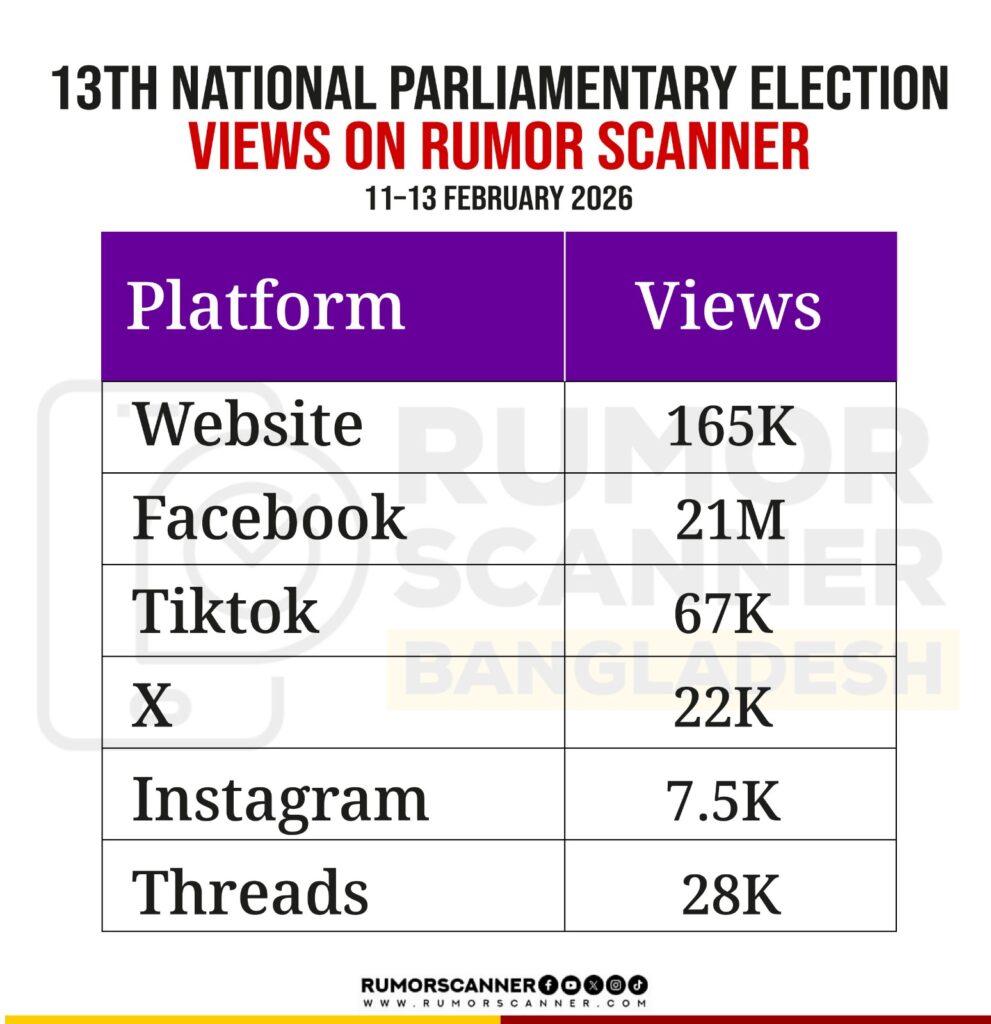
Between February 11 and 13, Rumor Scanner’s digital ecosystem spanning its main Facebook page, the dedicated election page, and its dual-language community groups (Bengali & English) exploded with engagement, amassing a staggering 21 million total views. Approximately 24,000 new followers joined Rumor Scanner’s official page in just three days. This massive reach underscored the public’s hunger for verified facts during the height of the political transition. A key driver of this traffic was the organization’s video content: just eight high-impact videos on the main page alone accounted for nearly five million views, proving that in a climate of uncertainty, Rumor Scanner’s visual storytelling became a trusted beacon for millions of voters.
Beyond uncovering the truth, Rumor Scanner’s findings became a primary resource for the nation’s mainstream media. During the critical three-day election window alone, their fact-checks were picked up and republished in at least 32 major news reports. On February 13, the national daily Prothom Alo featured Rumor Scanner’s data in its print edition under the headline “Disinformation surged even amidst festive polling,” while the previous day, The Daily Star ran a prominent piece titled “Disinformation spreads on the eve of election.” Even the state-run news agency BSS cited Rumor Scanner’s statistics on February 12, highlighting a targeted pattern of character assassination with the report, “Tarique Rahman becomes the primary target of election-time rumors.”
For over a year, mainstream broadcaster Ekattor TV has aired a daily segment titled ‘Fake News Scanner,’ dedicated to showcasing Rumor Scanner’s latest investigations. During the high-stakes period surrounding the election, the program’s broadcasts on February 10 and 14 prominently featured their fact-checks, drawing an impressive viewership of over 242,000. The momentum continued the day after the polls when the network aired a video report based on Rumor Scanner’s data, which quickly went viral on Facebook with 128,000 views.
On February 9, the Dhaka-11 political arena was shaken when Shamim Ahmed, the Jatiya Party candidate, filed a writ petition seeking to disqualify his rival, NCP candidate Nahid Islam. The petition alleged that Nahid held dual citizenship, claiming he had officially become a citizen of the Caribbean island nation of Dominica on April 20, 2025. However, the legal challenge was built on a foundation of digital sand. Weeks earlier, on January 20, Rumor Scanner had already debunked the “evidence”—a viral photo of a supposed Dominican passport. Their investigation proved that the image was a forgery created by taking a generic Dominican passport template from the internet and digitally grafting Nahid’s photo and signature onto it.
The story gained a second life when Nahid Islam and the NCP shared Rumor Scanner’s original fact-check to counter the court filing, sparking a massive wave of public discussion. The media quickly picked up on the truth, with a Facebook post by Jamuna TV alone drawing over 61,000 reactions. This high-profile case serves as a powerful reminder of how disinformation is being used to weaponize the legal system.
Having navigated the turbulent waters of this election, Rumor Scanner Bangladesh remains steadfast in its mission to serve as a neutral, unshakable guardian of public trust in the days to come.