

From Announcement to Campaign Trail: The Landscape of Electoral Disinformation
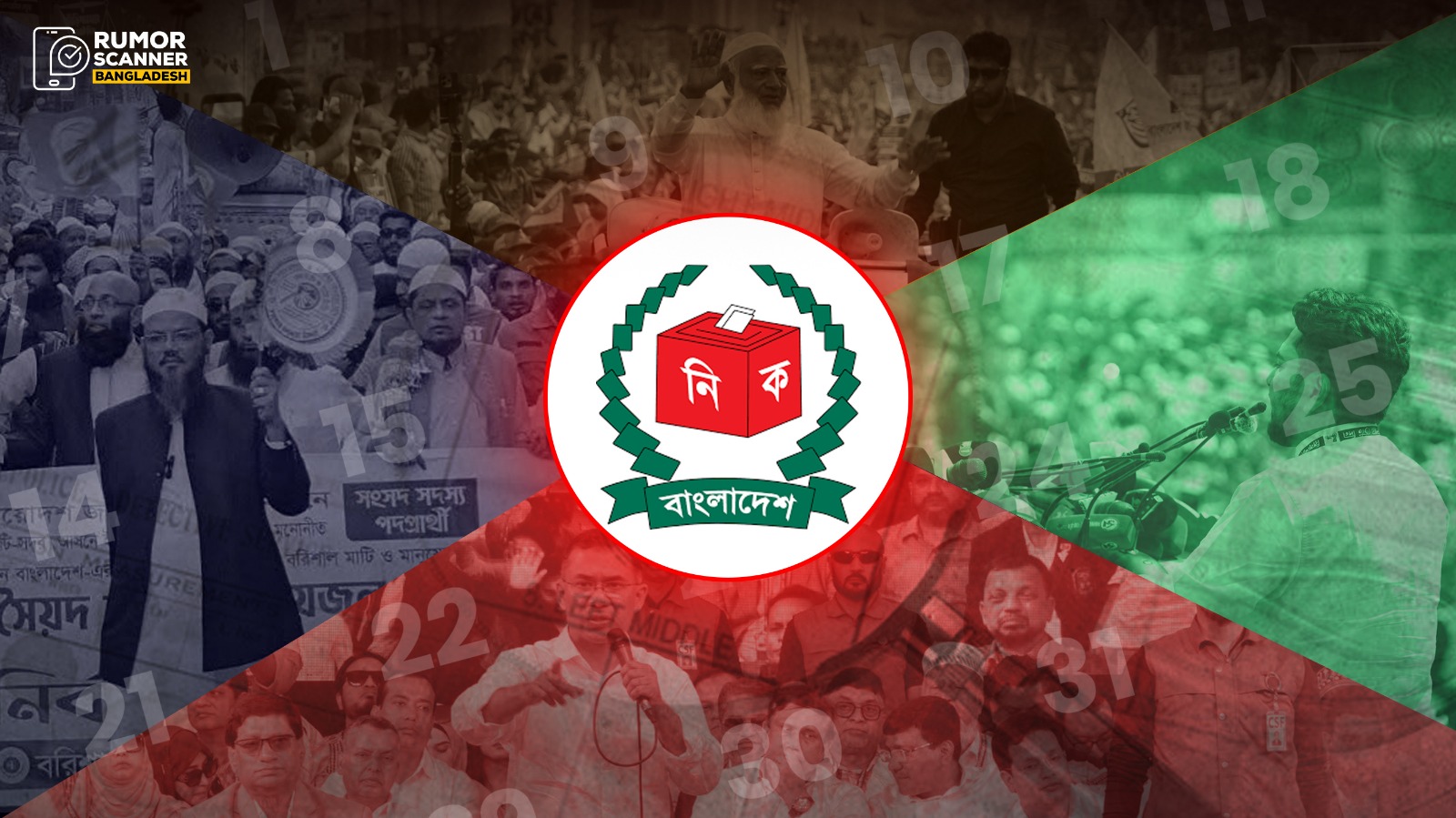
- 545 Disinformation Cases Identified from Election Schedule to Campaign Period
- 51 Parliamentary Candidates Fell Victim to Disinformation
- Tarique Rahman Tops List of Male Targets; Tasnim Jara and Rumeen Farhana Among Female Targets
- BNP Emerges as the Most Targeted Party in Election Disinformation
- AI Deepfakes, Photocards, and Edited Statements Fueled Most Disinformation
- 22 Disinformation Cases Targeted the Army, 14 Targeted the Police
It was a Friday. On December 12, just moments after the Jummah prayers, news broke that Sharif Osman Hadi, a potential independent candidate for Dhaka-8 in the parliamentary elections and spokesperson for the Inqilab Mancha had been shot in Bijoynagar, in the capital. Despite being flown to Singapore for advanced medical treatment, Hadi could not be saved. A week later, death claimed him.
The evening before he was shot, the schedule for the country’s 13th National Parliamentary Election had been announced, revealing that voting would take place on February 12. That date is tomorrow.
Alongside the parliamentary polls, a national referendum is also set to be held on the same day. The referendum, centered on the implementation of the July National Charter, is receiving equal significance in the political landscape.
Against this backdrop, Rumor Scanner sought to examine the flow of disinformation between the announcement of the election schedule and the formal campaign period of the candidates.
An analysis of election-related fact-checks published on Rumor Scanner’s website over the past two months shows that 545 pieces of disinformation were identified during this period alone.
Overall, since monitoring of election-related disinformation began in January 2025, Rumor Scanner has identified a total of 757 disinformation cases as of February 9.
Disinformation Intensified During Campaign Season
Of the 545 pieces of disinformation identified since the formal election process began on December 11 last year, 217 were detected between the announcement of the election schedule and January 21. Following the start of official campaigning, a further 328 cases were identified up to February 9 — indicating that the flow of disinformation was highest during the campaign period.
During this time, at least 23 pieces of disinformation were identified regarding the referendum.
Between December and February, 51 parliamentary candidates were directly targeted by disinformation, with a total of 352 false or misleading claims circulated about them. The overwhelming majority of the victims were men, 49 candidates, who were targeted with 340 pieces of disinformation. In contrast, two female candidates were targeted with a total of 12 false claims.
Among male candidates, BNP Chairperson Tarique Rahman, contesting from Dhaka-17 and Bogura-6 faced the highest volume of disinformation. Among female candidates, Tasnim Zara (Dhaka-9) and Rumeen Farhana (Brahmanbaria-2) were the most targeted. Both are running as independent candidates in this election.
Disinformation was observed in 47 parliamentary constituencies this cycle, with 129 false claims identified at the constituency level. Dhaka-8 recorded the highest number, with 51 pieces of disinformation detected. The constituency has remained in the spotlight for months. Sharif Osman Hadi had intended to contest from Dhaka-8. The BNP’s candidate there is veteran politician Mirza Abbas. Following Hadi’s death, young politician Nasiruddin Patwary nominated by Jamaat-e-Islami’s 11-party alliance is being viewed as a strong contender in the race.
Photocards Became a Key Weapon in Spreading Disinformation
Facebook emerged as the most influential platform for spreading disinformation, with 535 false or misleading pieces of content identified there. It was followed by TikTok (85 cases) and Instagram (76 cases), indicating that visually driven platforms also played a significant role in amplifying false narratives. Comparatively lower volumes of disinformation were observed on YouTube, X, and Threads.
A breakdown by format shows that photocards were the most widely used vehicle for disinformation (285 cases), followed closely by fake or edited statements (254 cases). In addition, 77 pieces of AI-generated deepfake content were identified, highlighting the growing risks posed by technology-driven manipulation.
Disinformation related to election violence accounted for 19 cases, while old photos or videos were recirculated as recent events in 25 instances. In 34 cases, satire or sarcasm pages were cited as sources to spread confusion. Overall, the patterns reveal that disinformation during this period was diverse, strategic, and increasingly sophisticated.
BNP and Tarique Rahman Top Targets in Disinformation Campaign
A party-wise analysis shows that the Bangladesh Nationalist Party (BNP) was the primary target of disinformation. Of the 360 identified pieces of disinformation concerning the party, 81 percent were negative in nature.
During this period, 14 BNP parliamentary candidates were directly targeted, with a total of 172 misleading pieces of content circulated about them. Among them, Tarique Rahman was the most targeted individual, with 133 pieces of disinformation identifie, 86 percent of which were negative.
By format, disinformation targeting the BNP was most frequently spread through photocards (145 cases) and fake or edited statements (112 cases). Additionally, 43 misleading contents were created using AI technology. There were also 10 cases of disinformation centered on election-related violence, often exaggerating or misrepresenting the situation.
A party-wise analysis clearly shows that Bangladesh Jamaat-e-Islami was also subjected to widespread disinformation during the election period. During the observation window, a total of 308 pieces of disinformation targeting the party were identified, nearly 90 percent of which carried negative narratives.
In this period, 11 Jamaat parliamentary candidates were directly targeted, with 89 misleading pieces of content circulated about them. The party’s Ameer, Dr. Shafiqur Rahman, faced the highest level of attacks, with 54 pieces of disinformation identified in his name, 98 percent of which were negative in tone.
By format, most disinformation targeting Jamaat was spread through photocards (110 cases). Additionally, 49 pieces were created using AI technology, while 45 involved fake or edited statements. There were also 11 cases related to election violence.
A distinct pattern also emerged regarding the National Citizens Party (NCP). During the observation period, 62 pieces of disinformation concerning the party were identified, 95 percent of which were negative. Seven NCP parliamentary candidates were mentioned in disinformation-related content, with a total of 40 misleading claims identified about them.
Individually, Hasnat Abdullah was the most targeted figure within the NCP, with 13 pieces of disinformation linked to his name — all of them negative.
Format-wise, disinformation concerning the NCP was evenly distributed between fake or edited statements (19 cases) and photocards (19 cases). Additionally, five AI-generated misleading contents and five cases related to election violence were identified.
Election monitoring also detected disinformation targeting Islami Andolon Bangladesh, though at a comparatively lower scale than other parties. During the observation period, 42 pieces of disinformation related to the party were identified, 59 percent of which were negative in nature.
Two parliamentary candidates from Islami Andolon Bangladesh were referenced in disinformation-related content, with a total of 14 misleading claims identified. Separately, the party’s Senior Nayeb-e-Ameer, Mufti Syed Muhammad Faizul Karim, was more frequently targeted, with 13 pieces of disinformation associated with him, 69 percent of which were negative.
By type, most disinformation targeting the party was photocard-based (22 cases). Additionally, five cases involved fake or edited statements, and three were related to election violence. Notably, no AI-generated disinformation targeting Islami Andolon Bangladesh was identified during this period.
Army Most Frequently Targeted by AI-Driven Disinformation
During the review period, multiple instances of disinformation were also identified involving security forces. A total of 22 pieces of disinformation targeted the Bangladesh Army. Among them, eight false claims centered on the Army Chief, Waker-uz-Zaman. Analysis shows that 59 percent of the disinformation involving the Army was generated using AI technology and circulated online. In addition, fake media photocards and misleadingly presented footage from various operations were used to portray the force negatively.
Similarly, 14 pieces of disinformation targeted the Bangladesh Police, half of which involved AI-generated content. Although comparatively fewer in number, one case each of disinformation was identified concerning the Rapid Action Battalion (RAB) and the Border Guard Bangladesh (BGB).
The overall pattern during the election period clearly indicates that disinformation was not isolated or incidental — it was planned, sustained, and strategic. A significant portion was disseminated during the campaign period and targeted specific parties and candidates, suggesting an intent to influence voter sentiment and erode public trust.
The widespread use of photocards and fabricated statements demonstrates that easily produced, rapidly shareable, and time-consuming-to-verify content has become a highly effective weapon. The presence of AI-generated deepfakes further signals an even greater risk for the future.
The fact that nearly all major political actors were subjected to negative disinformation suggests that this is not a problem confined to any single party, but rather a broader threat to the entire electoral environment. Meanwhile, the spread of disinformation targeting security forces appears aimed at casting doubt on the neutrality of state institutions.