

Polls, Lies, and Polarization: Students Sound the Alarm on Election Disinformation
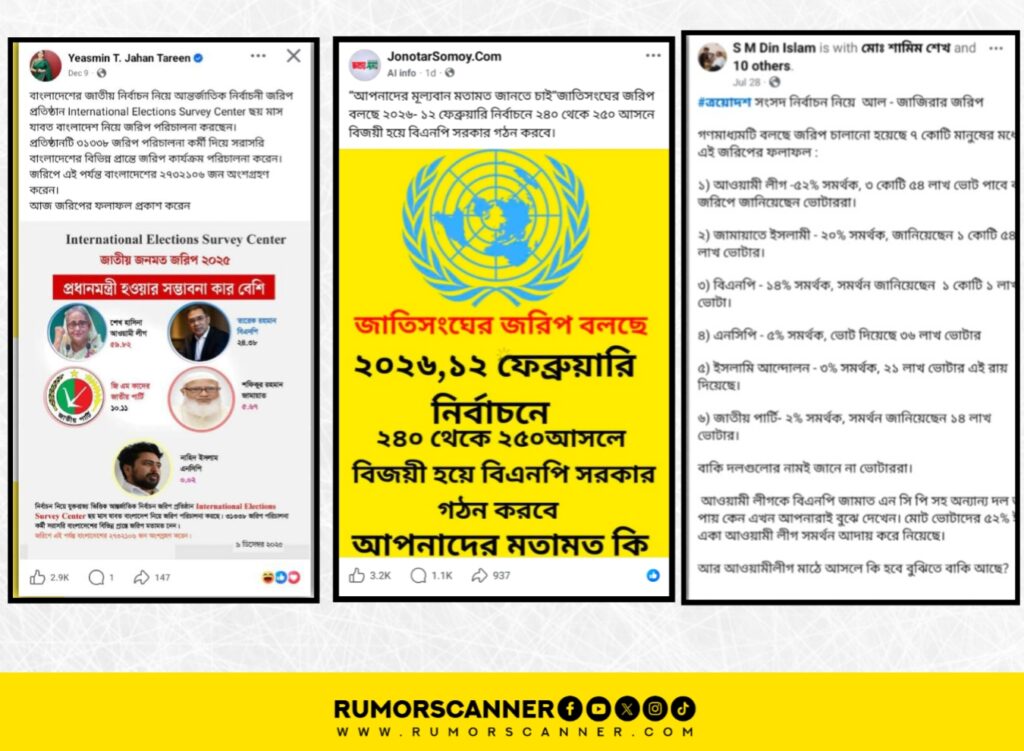
Since at least July to October of last year, information about a secret survey on the popularity of political parties in Bangladesh’s 13th national parliamentary election was being circulated online, citing the Qatar-based news outlet Al Jazeera. The circulated posts claimed that 70 million people participated in this secret survey. According to the claimed results, 52% supported the Awami League, 20% supported Jamaat-e-Islami, 14% supported BNP, 5% supported NCP, 3% supported Islami Andolan, and 2% supported the Jatiya Party. Rumor Scanner verified the claims and found that Al Jazeera did not conduct any such survey. The claim was circulated completely baselessly using the news outlet’s name.
As elections approach in any country, various surveys and opinion polls start circulating widely on social media and other online platforms. Headlines such as “Who is leading, who is trailing” are common, and these so-called surveys often attempt to influence voters’ attitudes. In reality, a large portion of these surveys are fake, misleading, or created without verifiable information.
Analyzing multiple fact-checks conducted ahead of Bangladesh’s upcoming election shows that such false surveys are being deliberately circulated, posing a significant risk to the electoral environment and the democratic decision-making process.
List of fake surveys
Infogram
Various entities—from media outlets to the UN—claimed as surveyors
From November 2024 to January of this year, Rumor Scanner has published 18 fact-checks related to the country’s political situation and election-focused fake surveys. Twelve of these fact-checks were published in December–January alone. Ahead of the election, these fake surveys seem to have become part of an unhealthy competition to show false public support.
A review by Rumor Scanner found that international media outlets were the most frequently used names as surveyors in these fake surveys. This list includes Al Jazeera, BBC, Reuters, and Voice of America. Among local media, the national daily “Amar Desh” was also falsely cited. Additionally, two fake surveys involved the United Nations.
Some of these fake surveys even used real organizations, such as Eminence Associates (EASD), while others cited entirely fictional organizations, like the “International Elections Survey Center”, as the surveyor.
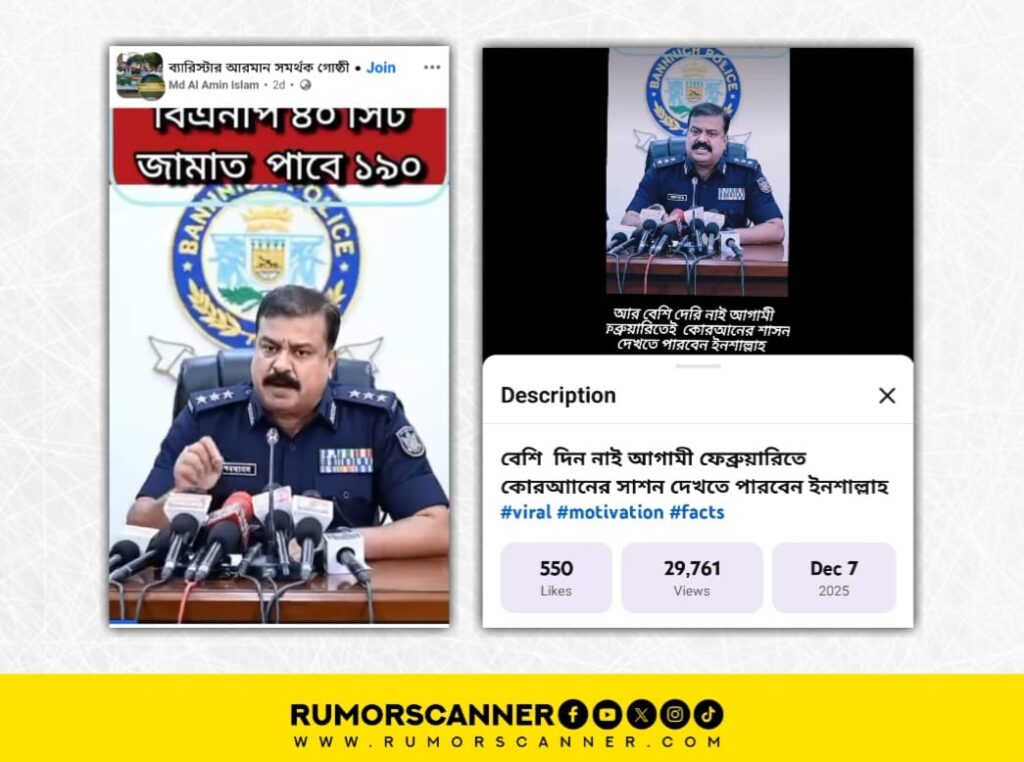
Interestingly, a fake claim has circulated that the Bangladesh Police conducted a survey on how many seats each party would win in the election, using an AI-generated video of a police officer making such a statement.
Media photo cards, sarcasm pages turned into weapons of Disinformation
Ahead of the election, a new dimension has been added to the spread of fake surveys—fake photo cards created using the logos and designs of credible media outlets. According to Rumor Scanner’s observations, three fake photo cards were made using RTV, and one each using NTV, Jamuna TV, Amar Desh, and Ekattor TV, and circulated online.
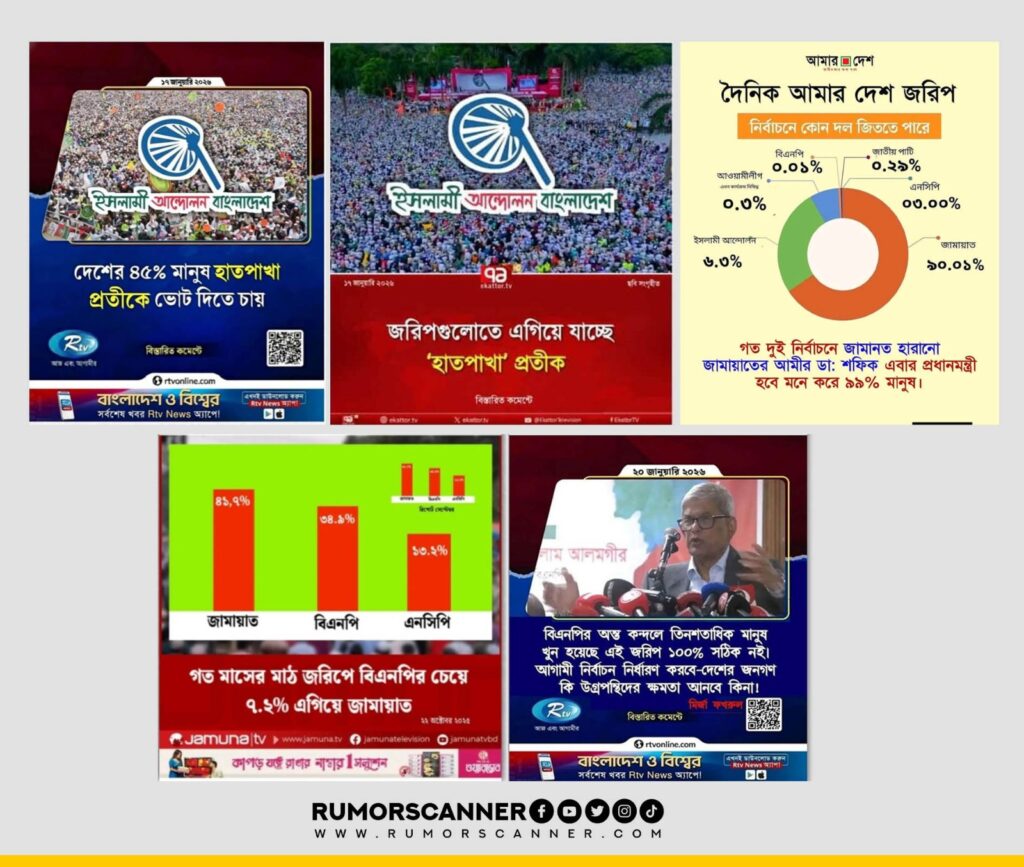
Although these photo cards present survey results, the respective media outlets have never published such information. Analysis of fact-check data shows that these intentionally created visuals are being used to mislead voters, posing a serious threat to electoral transparency.
Ahead of the election, various sarcasm or satirical pages have been identified as one of the sources spreading fake surveys on social media. Although these posts present made-up survey results in a “fun” or satirical tone, they have no connection to any real survey or reliable data. For example, a survey published by the national daily Prothom Alo on 8 December last year showed that 28% of respondents did not want to vote for the Awami League, while 69% wanted to, either unconditionally or conditionally. The very next day, a Facebook page named Gorom TV posted a photo card titled: “65% of people will not go to the polling station except for Awami League: Survey!”
However, the post does not provide any source or evidence. This post, which originated from a satirical page, has been circulated as if it were real news. One such post received nearly ten thousand reactions and just under 1,500 comments. The page Gorom TV primarily creates and shares content for entertainment purposes.

Fact-check data indicates that posts from these sarcasm pages later spread among general users without the satirical context, and in many cases, are treated as genuine public opinion surveys. As a result, an effective pathway for spreading electoral disinformation is being created under the guise of humor or satire.
Bogus surveys inflate Awami League support even though it’s out of the race
Analysis of the fake surveys fact-checked by Rumor Scanner shows that a large portion of them favor specific political parties. Among the identified fake surveys, the Awami League was shown as ‘leading’ the most—6 cases. This is followed by Jamaat-e-Islami (4 cases) and Islami Andolan Bangladesh (2 cases). Comparatively, fewer fake surveys showed BNP as ‘leading’—only 1 case.
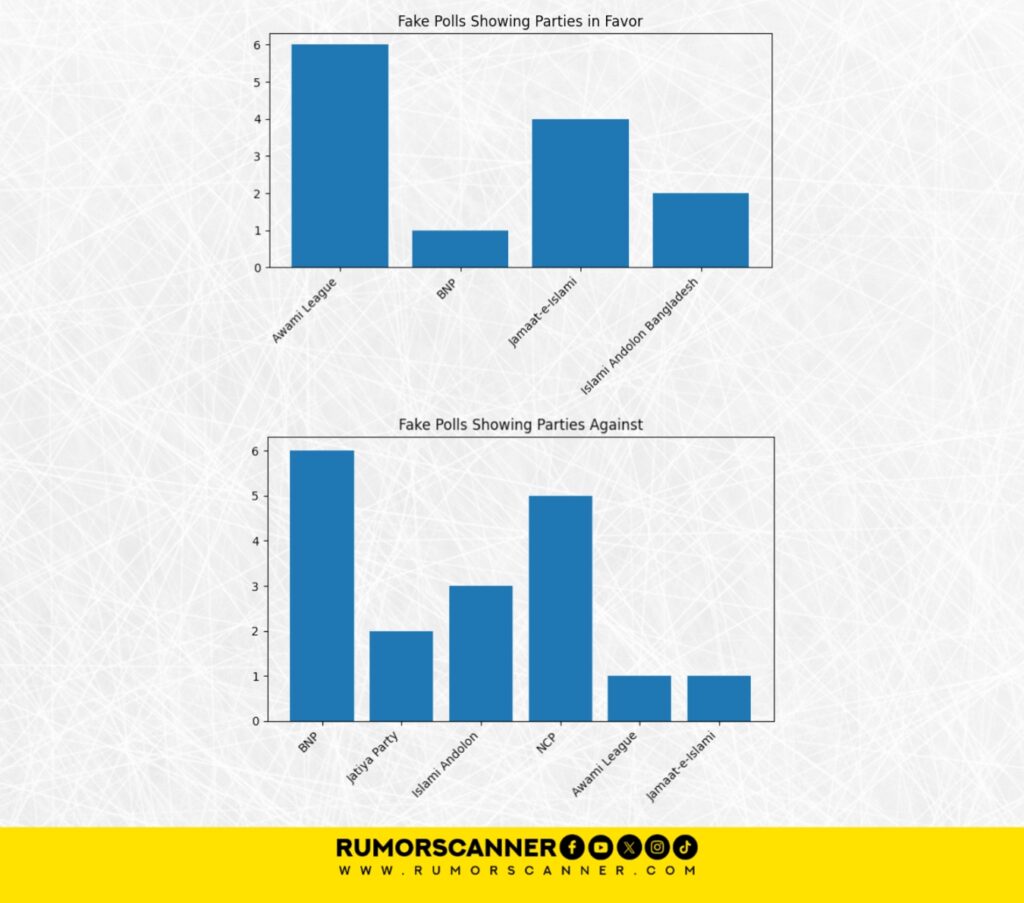
Another part of the fact-checked fake surveys shows a clear trend of portraying certain political parties negatively. According to Rumor Scanner’s analysis, BNP was depicted most negatively—in 6 fake surveys. This is followed by NCP (5 surveys) and Islami Andolan (3 surveys). The Jatiya Party was shown negatively in 2 cases. Comparatively, fewer fake surveys portrayed the Awami League and Jamaat-e-Islami negatively—only 1 case each.
Analysis of the fact-checked fake surveys at the individual level shows that in terms of positive portrayal, Awami League President Sheikh Hasina appeared most frequently—in 2 fake surveys. Jamaat-e-Islami Amir Dr. Shafiqur Rahman was shown positively in 1 survey.
On the other hand, the negative portrayal list includes multiple political figures. BNP Chairman Tarique Rahman was depicted negatively the most—in 2 fake surveys. Additionally, Interim Government Chief Adviser Dr. Muhammad Yunus, NCP Convener Nahid Islam, Dr. Shafiqur Rahman, and Jatiya Party Chairman GM Quader were each shown negatively in 1 fake survey.
This analysis suggests that fake surveys are used not only to target political parties but also to shape positive and negative narratives about individual political leaders.
Survey by Rumor Scanner shows student enthusiasm for voting
Ahead of the upcoming national parliamentary election, Rumor Scanner conducted a small-scale survey at various universities in the country to get a preliminary idea of the flow of region-based disinformation. The survey was carried out from 4 to 11 November last year among a total of 97 students studying at 27 universities. Of the participants, 61 were male and 36 were female students.
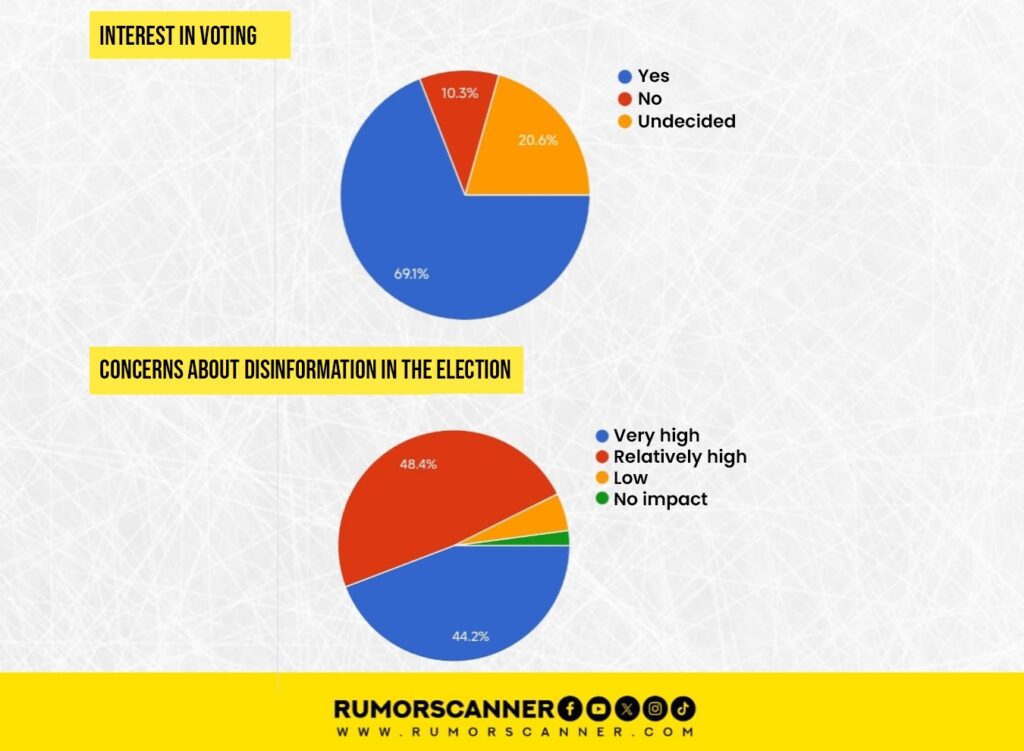
In the survey, over 69% of participating students expressed interest in voting in the upcoming election. At the same time, 46% of students evaluated the electoral environment in their parliamentary constituency as ‘good’. However, concerns about the impact of disinformation on the electoral process are also evident. 47% of the surveyed students believe that electoral disinformation can create divisions among voters and political activists and has the potential to incite violence.
When asked about the potential impact of disinformation on the upcoming election, more than 44% of students expressed concern that its effect would be ‘very high’. Participants also noted that in recent months, the amount of fake and misleading information related to the election on social media has increased. The most frequently mentioned issue (67% of students) was the distortion of statements made by political figures. Other concerns included fake media photo cards, AI-generated videos, and the re-circulation of old videos—with 53%, 52%, and 47% of students, respectively, acknowledging these trends.
Nearly 80% of students believe that political parties extensively use disinformation as a strategy during election campaigns. Consequently, about 94% of students hold political parties and their leaders responsible for spreading disinformation.
The survey also highlighted students’ awareness of AI and deepfakes. Among participants, 72% reported being aware of both AI and deepfakes, while slightly over 4% stated that they are unaware of either. Additionally, 84% of students believe that all election campaign content generated by AI should be required to carry an ‘AI-generated’ label.
However, dissatisfaction with the Election Commission’s role in tackling electoral disinformation is evident—nearly 70% of students reported being dissatisfied with its performance in this regard.