

- 155 instances of disinformation about Bangladesh identified across Indian media and social platforms.
- Evidence of disinformation in 140 reports across 38 incidents in 73 media outlets of the country.
- Nearly 58% of the identified misinformation pertains to communal incidents.
- In 33 incidents, Muslims were falsely portrayed as Hindus.
The trend of disinformation about Bangladesh originating from Indian sources is becoming increasingly alarming. In 2025, Rumor Scanner found evidence of at least 155 instances of disinformation about Bangladesh across various Indian media and social platforms, nearly 5% higher than the previous year. These figures not only highlight the spread of disinformation but also reveal a persistent upward trend. Even more concerning is the active role of mainstream Indian media in spreading these falsehoods. Last year, 73 Indian news outlets published a total of 140 reports across 38 incidents, all containing misleading or false information about Bangladesh.
Disinformation peaked at the start of the year
For the past few years, various Indian accounts, pages, and mainstream media have been consistently spreading disinformation about Bangladesh on social platforms. This trend continued in 2025 as well. In fact, at the start of the year, Indian sources circulated 34 instances of disinformation in January alone—the highest number recorded for any single month last year.
Although the numbers dropped slightly in the following months, the flow of disinformation did not stop. In May, the fewest instances—just four—were recorded. Yet, Rumor Scanner found that Indian accounts and media coordinated to spread an average of at least 13 pieces of disinformation per month last year.
The threat of X remains unabated
Microblogging platform X (formerly Twitter) has consistently been the most used platform for spreading disinformation about Bangladesh by Indian sources. Last year, out of 155 instances of disinformation, Rumor Scanner found evidence of 126 being circulated through various X accounts—meaning nearly 81% of all disinformation appeared on X.
Beyond X, Indian accounts and pages spread 54 instances of disinformation about Bangladesh on Facebook last year. Other platforms involved include YouTube, Instagram, Threads, and TikTok. Even Indian mainstream media played a role, propagating disinformation in at least 38 separate incidents.
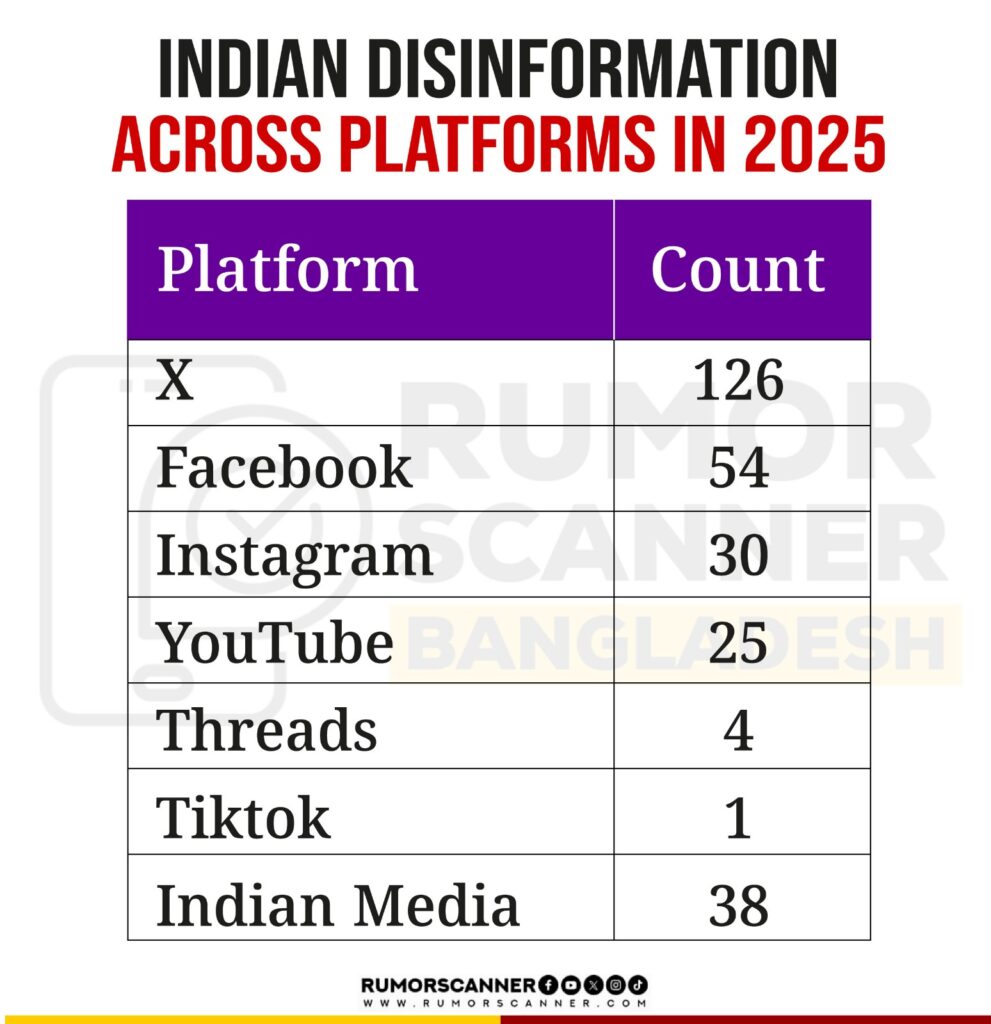
These findings clearly show that digital platforms have become the primary medium for spreading disinformation about Bangladesh from Indian sources. Among them, X plays the most influential role. When over 80% of the identified disinformation in a single year is concentrated on one platform, it signals not just a statistic but a structural trend—an organized effort to create and disseminate a specific narrative.
Even more concerning is the involvement of Indian mainstream media. Disinformation spread through the media carries far greater credibility among the public and directly influences opinion formation.
Unbridled Communal Propaganda
In 2025, Rumor Scanner identified 155 instances of disinformation spread by Indian sources, of which 91 were communal in nature. This means nearly 58% of the detected disinformation related to communal incidents. The primary platform for spreading such communal disinformation is X, where Indian sources circulated at least 85 communal falsehoods last year.
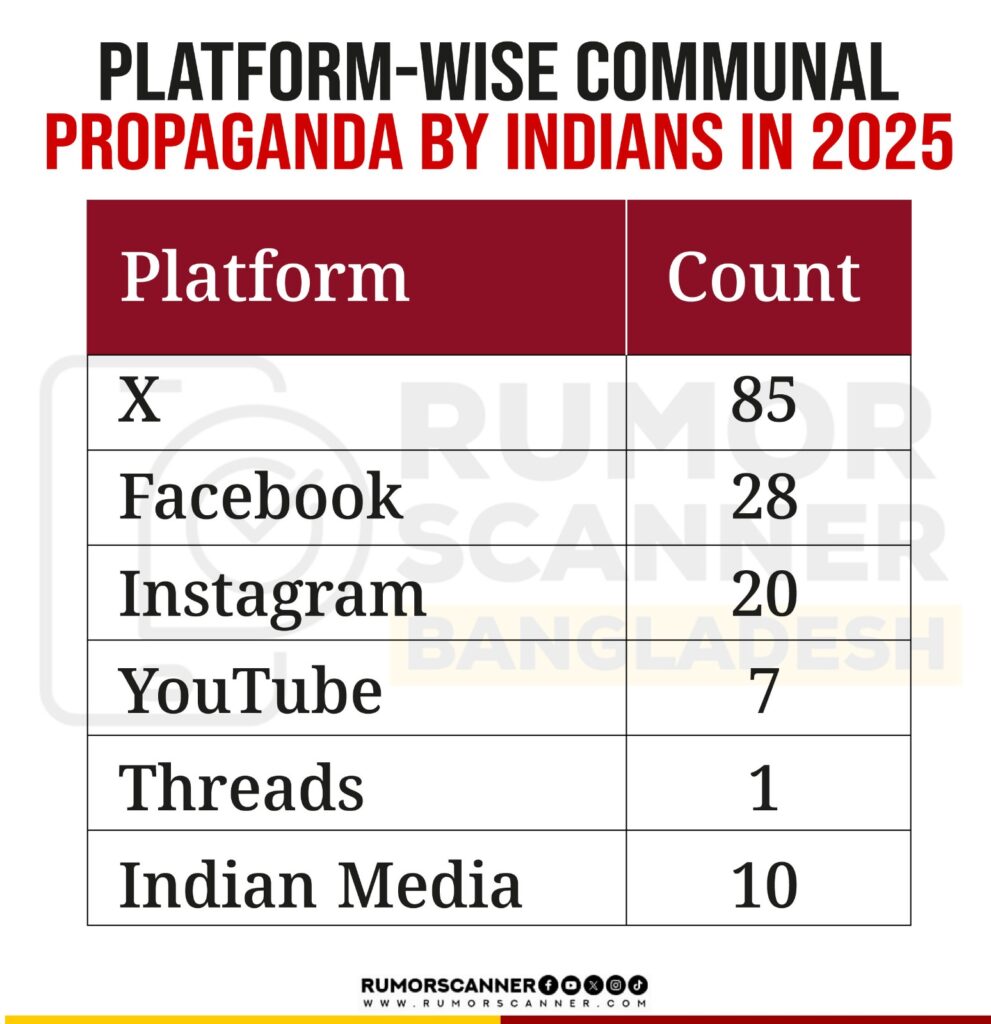
Indian mainstream media have also played a role in this campaign of communal propaganda. Evidence shows that in at least 10 incidents, Indian media outlets spread communal falsehoods involving Bangladesh. Among the platforms implicated are major outlets such as NDTV, The Times of India, Zee News, WION (World Is One News), India Today, Hindustan Times, News18, TV9, ABP, and Mirror Now.
These statistics raise deeper concerns. They reveal not just the volume of disinformation, but also its nature and intent. A significant portion of the 155 identified falsehoods consists of content capable of directly stoking religious divisions. This indicates that a substantial part of the disinformation originating from Indian sources about Bangladesh is being deliberately propagated to foment communal tensions.
Disinformation about Bangladesh across 73 Indian media outlets
In 2025, Rumor Scanner analyzed fact-checks of disinformation circulated in Indian media and found that in 38 incidents, 73 news outlets published disinformation involving Bangladesh. The number of misleading reports per outlet ranged from as many as 10 to as few as one. A total of 140 reports across these 73 outlets were verified, all containing evidence of disinformation.
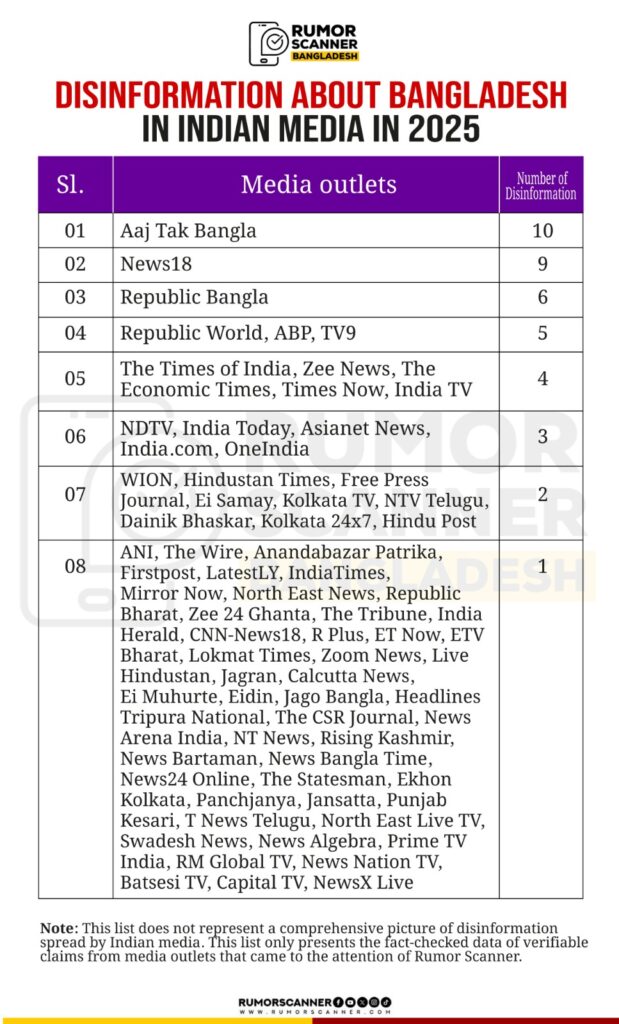
In terms of sheer volume of disinformation, the Indian satellite news channel ‘Aajtak Bangla’ tops the list. Out of 32 incidents, this channel spread disinformation in 10 cases. In 2024, Aajtak Bangla ranked fourth on this list.
On July 9 last year, Lal Chand, also known as Sohag, a scrap dealer in Dhaka’s Mitford area, was brutally murdered. Following this, at least 27 Indian media outlets falsely claimed that Sohag was a Hindu—a completely untrue assertion. This single incident received the highest coverage among Indian media last year.
Additionally, Rumor Scanner found that 16 Indian outlets spread disinformation in December around James’ concert in Faridpur, and 12 outlets propagated false claims in June regarding the revocation of recognition for Sheikh Mujibur Rahman and other national leaders as freedom fighters.
It is important to note that this list does not represent the full scale of disinformation by Indian media. Only verifiable claims that were fact-checked by Rumor Scanner are included. Instances that escaped fact-check scrutiny could make the actual picture far graver.
Disinformation portraying Muslims as Hindus is widespread
Last year, the most common type of disinformation and communal propaganda targeting Bangladesh involved falsely portraying a Muslim victim of an attack or assault as a Hindu, framing it as a communal incident. Rumor Scanner identified at least 33 such instances in 2025.
Another familiar pattern is presenting older incidents as recent communal attacks in Bangladesh—Rumor Scanner documented at least eight such cases.
Even scripted content created for entertainment was falsely presented as real, with at least six such instances detected. In five cases, the events actually occurred in India, yet were falsely claimed to have happened in Bangladesh.
Beyond these, Indian mainstream media, alongside social platforms, were active in spreading disinformation about various internal issues in Bangladesh during this period.
Is Bangladesh becoming a guinea pig for subcontinental crises?
Disinformation originating from India is steadily increasing. Rumor Scanner spoke with Indian journalist Arka Bhaduri, who warned that the impact of disinformation is severely damaging relations between the people of India and Bangladesh. Misconceptions are being formed about each other, giving rise to intense hatred and hostility, which then spill over onto social media.
Rajib Nandy, Associate Professor of the Department of Communication and Journalism at the University of Chittagong believes Bangladesh also bears responsibility. In his conversation with Rumor Scanner, he said, “The unchecked rise of mob violence, repeated communal attacks, and the absence of strong and credible responses at the state level are effectively providing real-world raw material for the exaggerations of Indian media. Weak governance, failure to maintain law and order, and the lack of a clear political stance against violence are making the situation even more complex.”
Rajib fears that if Bangladesh’s governance system fails to take a clear, firm, and moral stand against violence, these distorted and exaggerated narratives in the neighboring country’s media will continue to be reproduced in the future.
According to this media researcher, disinformation is no longer merely a journalistic failure; it has become a strategic tool for shaping public opinion and political narratives about a neighboring state.
Arka has long been vocal on this issue and has discussed it in both Bangladeshi and Indian media. The Kolkata-based journalist believes that the subcontinental roots of communal tensions affect both countries.
“Communal violence undeniably exists in Bangladesh. It existed even during the Awami League’s tenure—we saw incidents like Nasirnagar, Ramu, and the bloody violence in Durga Puja of 2021. The problem still persists, just as minorities are also under threat in India. This is not the problem of any one country; it is a curse on the entire subcontinent. But when mainstream media spreads false and exaggerated information, the problem becomes trivialized—and that is dangerous.”
Beyond specific incidents, flows of disinformation from Indian sources appear at various times. When asked whether governments or policymakers in either country should be blamed for failing to take effective measures, Arka expressed skepticism. “I don’t think governments can realistically do much; any intervention would immediately be criticized as interference in media freedom.”
He believes that fact-checking and building people-to-people connections between the two countries offer the most viable way to ease the situation.
When asked whether Indian domestic politics is accelerating anti-Bangladesh narratives, Rajib Nandy responded that political positions on minority rights in India cannot be seen as uniformly anti-Bangladesh. “It is primarily a combination of domestic vote-bank politics, identity sensitivity, and strategic political messaging.”
However, Rajib also believes that through visual exaggeration, dramatic language, and unverified information, sections of the Indian media are crossing ethical boundaries and constructing emotionally charged, conflict-driven narratives.
Methodology
These statistics are based on reports published on the Rumor Scanner website from January to December 2025. For the purpose of preparing this analysis, data from each report over the past year were systematically collected and stored in a dedicated database. The data were then analyzed, and the findings were subsequently presented through infographics and written content. Finally, two experts from Bangladesh and India were interviewed to provide insights on the results.