

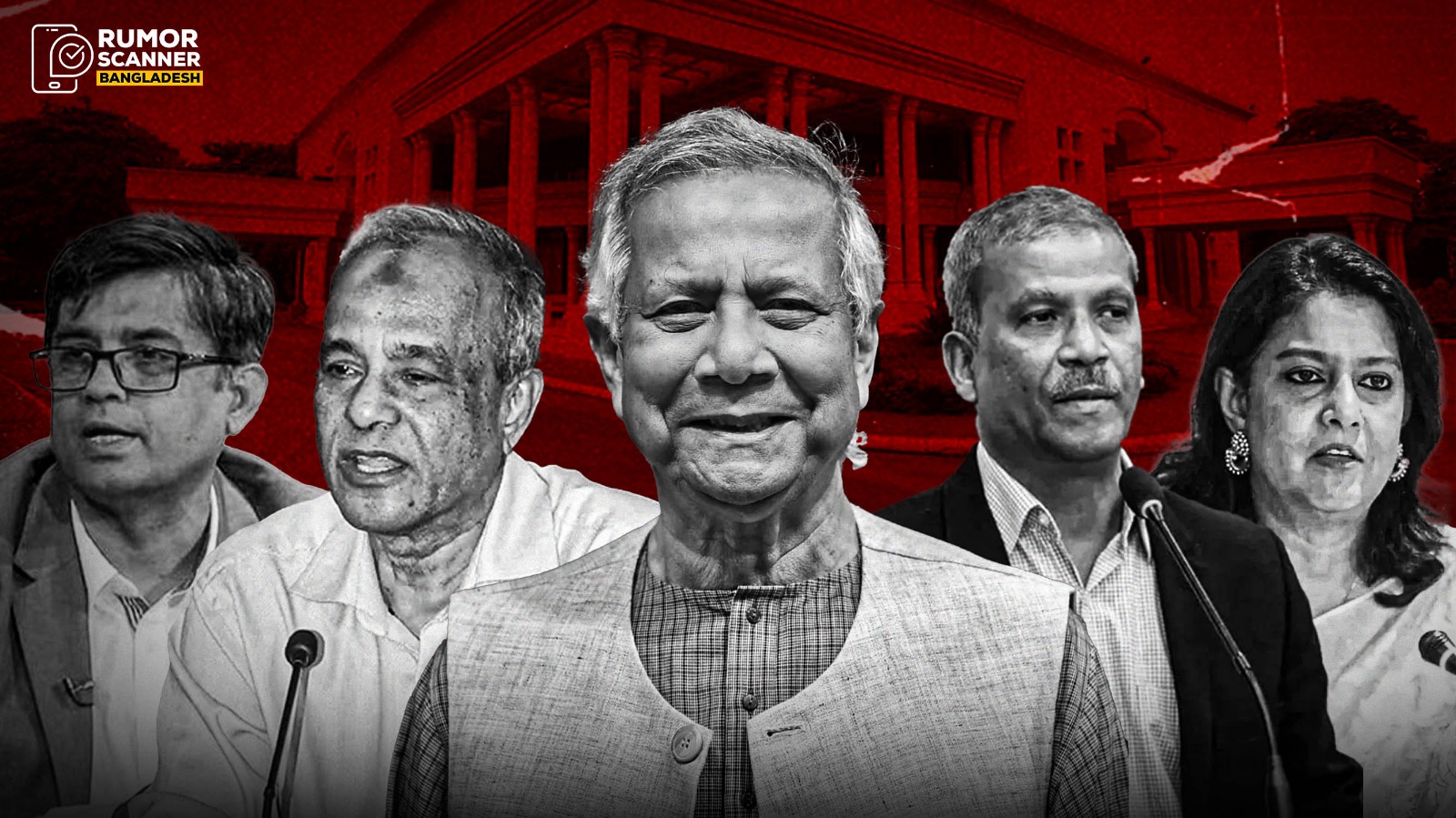
The journey began on August 8, 2024, when Nobel Laureate economist Dr. Muhammad Yunus took the oath as Chief Adviser, marking the start of the interim government. Within twenty-four hours, a false claim—citing the mainstream news outlet Channel 24—began circulating on social media, asserting that the interim government had been granted a six-year term. Similar misinformation was later propagated using Jamuna TV as a fabricated source. Upon verification, Rumor Scanner confirmed that neither media outlet had ever broadcast such information; the names of these trusted organizations were weaponized solely to lend credibility to a lie.
This was only the beginning. Over the next 18 months, the interim government became a constant target of digital deception. A comprehensive review of fact-checks published on the Rumor Scanner website reveals a staggering 888 instances of misinformation targeting the interim government, its advisers, and the Press Wing during this period. Within this same timeframe, 364 separate false claims were identified specifically targeting Dr. Yunus himself, illustrating a persistent and coordinated effort to undermine the transition of power through the spread of digital falsehoods.
Dr. Yunus: A Prime Target of Negative Campaigns
In late May 2025, a wave of rumors suggested that Dr. Muhammad Yunus was on the verge of resigning as Chief Adviser. These reports claimed he had expressed deep frustration over numerous obstacles—ranging from road-blocking protests to a lack of consensus among political parties regarding state reforms and non-cooperation from various factions. As these claims ignited intense debate across social media and beyond, Rumor Scanner identified at least 16 instances of fake news concerning his resignation in just four days. Throughout his 18-month tenure, Dr. Yunus has been the target of at least 25 separate disinformation campaigns specifically revolving around his supposed resignation, highlighting a persistent effort to project instability within the interim leadership.

The tactics used to spread rumors of his resignation have been as diverse as they are deceptive, ranging from fabricated news on free Blogspot domains and recontextualized old protest footage to forged resignation letters and the chilling use of deepfake videos.
Beyond the sphere of governance, Dr. Yunus’s family has also been targeted by a relentless smear campaign during his time in office. One of the most viral incidents occurred in November 2024, when a video began circulating with the claim that it showed his daughter, Monica Yunus, being detained for driving while intoxicated. However, a verification by Rumor Scanner revealed that the woman in the video was not Monica Yunus; her identity had been falsely appropriated to damage the Chief Adviser’s reputation. The disinformation reached absurd levels when an Indian media outlet misidentified a woman as Professor Yunus’s “ex-wife,” and in another instance, his other daughter, Dina Afroz Yunus, was even falsely presented to the public as his wife. These orchestrated attacks demonstrate that the strategy of disinformation extends far beyond political critique, stooping to personal and familial character assassination to create a narrative of instability.
Photocards: The Main Tool in Misinformation Targeting Advisers
During their 18-month tenure, Rumor Scanner identified a total of 231 instances of disinformation targeting 21 advisors of the interim government. The most frequent victim of these attacks was Law Advisor Professor Dr. Asif Nazrul. Out of the 67 false claims directed at him, approximately 21% were propagated through fake photocards. These often involved fabricated quotes designed to incite public anger; for instance, in December last year, a photocard went viral claiming he said, “Expatriates do not need to stay in the country for more than 60 days.” This single piece of disinformation was viewed at least 1.5 million times across various social platforms before being debunked. Dr. Nazrul later shared the fact-check on his own Facebook page to clear the air.
Similarly, Jahangir Alam Chowdhury, who held the portfolios for Home Affairs and Agriculture, was targeted by 31 instances of disinformation. A staggering 94% of these were designed to cast him in a negative light. During his time in office, he became a central figure in cross-border information wars, frequently falling victim to “Hindu persecution” narratives amplified by certain Indian media outlets. These reports often stripped events of their context to portray a state of lawlessness, directly challenging the advisor’s credibility and the government’s stability.
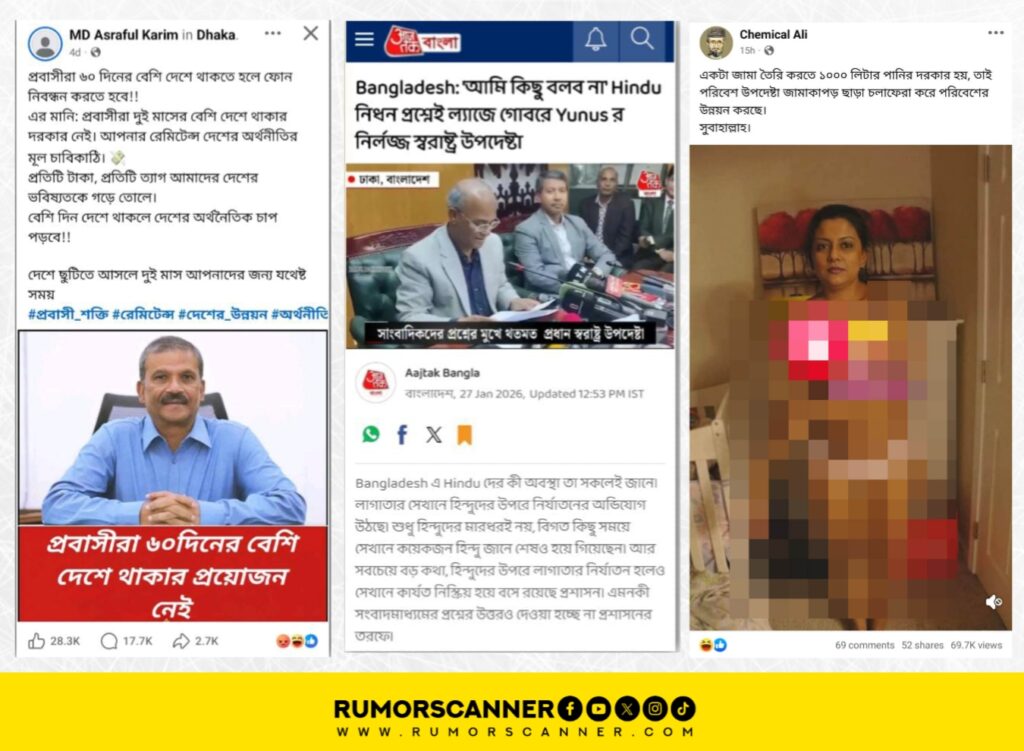
Female advisors within the interim government have faced a particularly concentrated and often gender-coded wave of disinformation. Rumor Scanner identified a total of 30 false claims targeting four key female advisors: Syeda Rizwana Hasan, Farida Akhter, Nurjahan Begum, and Sharmeen S. Murshid.
The vast majority of these attacks—26 out of 30—were directed at Syeda Rizwana Hasan. During her tenure, she was the target of at least three instances of highly offensive and fabricated content. Most peculiar, however, was a recurring narrative involving birth control; at least seven different pieces of disinformation were circulated claiming she had made controversial comments regarding a specific contraceptive method—a topic entirely unrelated to her professional jurisdiction.
Another advisor frequently caught in the crosshairs is A.F.M. Khalid Hossain. As a prominent Islamic scholar serving as the Advisor for Religious Affairs, he was the subject of 11 identified instances of disinformation over the 18-month period. A recurring tactic in these attacks involved the use of “imposter” social media accounts. In at least three cases, comments made by fake Facebook profiles bearing his name were presented as his official statements, leading to widespread—and entirely misplaced—criticism across social media platforms.
The Young Guard: Navigating a Digital Minefield
On August 8, 2024, as the interim government took office, two prominent figures of the July movement, Nahid Islam and Asif Mahmud Shojib Bhuyain, were sworn in as advisors. They were joined on November 10 by Mahfuj Alam, who had previously served as a Special Assistant to the Chief Adviser. However, as political transitions unfolded, their roles shifted: Nahid Islam resigned on February 25, 2025, to lead the newly formed National Citizen Party (NCP), while Asif Mahmud and Mahfuj Alam stepped down on December 10, 2025—just ahead of the official announcement for the 13th National Parliamentary Election—to clear their path for the polls.
During their time in office, these three young advisors were the targets of 56 documented instances of disinformation. Among them, Asif Mahmud Shojib Bhuyain bore the brunt of the attacks. Perpetrators used nearly every tool in the disinformation handbook against him: forged photocards, AI-generated content, manipulated images, fabricated quotes, and out-of-context videos.
In one particularly viral case, a video surfaced claiming to show Asif’s father leading a violent attack after his son gained power. However, a verification by Rumor Scanner proved that the man in the video was not Asif’s father. Demonstrating a commitment to transparency, Asif personally shared the fact-check on his Facebook page to debunk the narrative. These coordinated efforts against the youth leaders highlight a clear strategy to undermine the legitimacy of the uprising’s primary architects by attacking their personal integrity and family reputation.
In February 2025, while serving as advisors, Nahid Islam and Asif Mahmud Shojib Bhuyain, along with other government officials and movement coordinators, became the targets of a sophisticated financial smear campaign. Claims began circulating that they held international cryptocurrency accounts on the Binance platform containing massive amounts of Bitcoin, allegedly worth hundreds of millions of dollars.
The disinformation gained further traction when certain Indian media outlets amplified these claims. However, an investigation by Rumor Scanner revealed that the screenshots presented as “proof” of these Binance accounts were entirely fabricated. The investigation concluded that these images were created using digital manipulation and were being disseminated through unreliable sources to create a narrative of corruption. This incident highlights how high-tech financial hoaxes are being weaponized to undermine the integrity of the uprising’s leadership on a global scale.
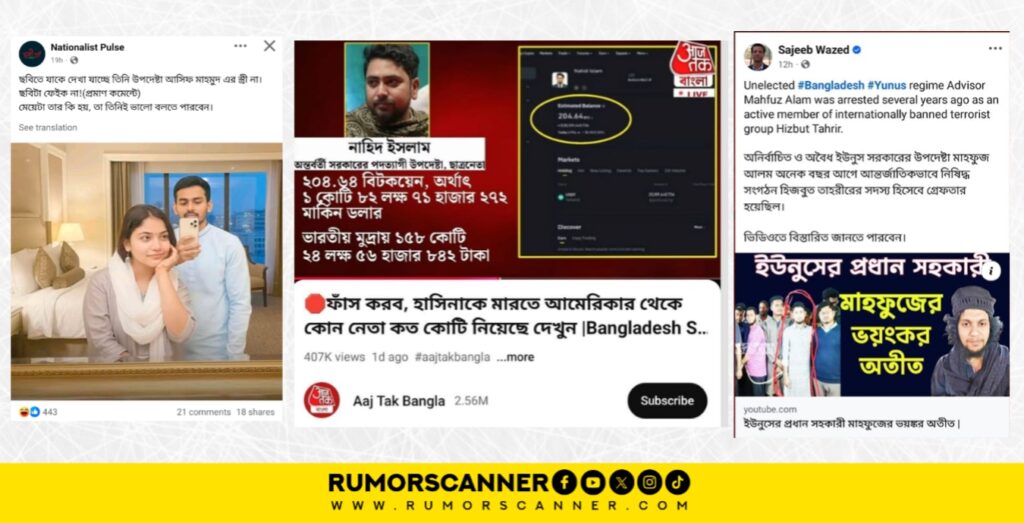
One of the most sensitive pieces of disinformation involved Mahfuj Alam, who was falsely accused of ties to the banned organization Hizb-ut-Tahrir. In November 2024, a screenshot of a report from the national daily The Business Standard, originally published in 2019, began circulating on social media. The claim suggested that the “Mahfuz” arrested by the Counter-Terrorism Unit in Chittagong in November 2019 was the same person as Mahfuj Alam. However, an investigation by Rumor Scanner confirmed that these were two different individuals who happened to share a common name. Despite this verification, the false narrative persisted. Sajeeb Wazed Joy, the son of former Prime Minister Sheikh Hasina, further amplified the claim by sharing it on both his Facebook page and X (formerly Twitter) profile, giving the debunked rumor a second life among millions of followers.
Shafiqul Alam: The Press Secretary in the Eye of the Storm
As the bridge between the government and the public, the Chief Adviser’s Press Wing was established immediately after the interim government took office. Heading this wing was Shafiqul Alam, a seasoned journalist from the international news agency AFP. Over the course of 18 months, Rumor Scanner identified 30 instances of disinformation specifically targeting him.
The spotlight intensified on Shafiqul in February 2025 during the Amar Ekushey Book Fair. The Anti-Discrimination Student Movement had installed dustbins featuring a “Pillar of Hatred” (Ghrina Stambha)—a graphic representation of the ousted leader Sheikh Hasina. Shafiqul Alam was photographed disposing of trash into one of these bins, an act that triggered a firestorm of criticism from Awami League loyalists.
Following this incident, the digital attacks escalated from political critique to personal vitriol. Not only was he targeted with fabricated stories, but the campaign also stooped to a new low by disseminating offensive and false content involving his daughter. This pattern reflects a broader trend observed by Rumor Scanner: whenever a government official takes a public stance that challenges the previous regime’s legacy, they—and their families—become immediate targets for coordinated character assassination.

At various subsequent times, counterfeit media photocards were used to attribute false statements to him.
A Government Under Siege: The Pressure of Perpetual Misinformation
From its inception on August 8, 2024, until the transfer of power on February 17, 2026, the interim government faced a relentless barrage of challenges, both political and digital. Over this 18-month period, Rumor Scanner identified at least 40 major issues that each triggered five or more instances of disinformation. The most significant blow to the administration was the shooting of Sharif Osman Hadi, a potential independent candidate for Dhaka-8 and spokesperson for Inqilab Manch, who was attacked on December 12, 2025, just one day after the election schedule was announced. Following his death in Singapore on December 18, a staggering 115 instances of disinformation were identified surrounding the tragedy. Similarly, the legal proceedings against ousted Prime Minister Sheikh Hasina for crimes against humanity became a magnet for falsehoods; when the verdict date was announced on November 13, 2025, it prompted a “lockdown” call from the banned Awami League and generated 78 unique pieces of disinformation.
Other political flashpoints throughout the year were equally besieged by digital deception. Significant disinformation counts were recorded across various events: 79 cases surrounding the student council elections at five major universities, 38 cases related to the NCP march in Gopalganj, and 34 cases concerning the return of BNP Chairman Tarique Rahman in December. Smaller yet impactful waves of disinformation were also documented, including 21 cases regarding the August 15 observance, 19 cases involving the murder of businessman Sohag at Mitford Hospital, and 11 cases concerning the fire at Dhanmondi 32. This persistent “shadow narrative” of disinformation accompanied every major national event, highlighting the immense pressure under which the interim government operated as it navigated the country’s transition.
The Greatest Challenge: Unchecked Election Disinformation
Throughout the one-and-a-half-year tenure of the interim government, Chief Adviser Dr. Muhammad Yunus repeatedly emphasized that the administration’s primary goal was to hold national elections as soon as essential reforms were completed. Speculation surrounding the timeline remained a central topic of public and political discourse until December 11, 2025, when the official schedule was announced, setting the highly anticipated election for February 12, 2026.
However, as the electoral process unfolded, it became clear that the rampant spread of misinformation would be one of the government’s greatest challenges. The digital space was flooded with fake news, misleading claims, and manipulated content designed to derail the transition. Rumor Scanner, which began monitoring election-related content in January 2025, identified at least 1,071 instances of misinformation over the course of the year. Crucially, 545 of these cases—more than half—were detected between the announcement of the schedule and the formal campaign period, indicating that the flow of disinformation was most intense during the most sensitive window of the election.
To combat this, the Chief Adviser’s Press Wing launched a dedicated “Fact Check” Facebook page in October 2024, which published 724 posts before ceasing operations on February 21, 2026. While the page primarily amplified the work of established fact-checking organizations to provide the public with verified information, the sheer volume of disinformation raises questions about the long-term effectiveness of such reactive measures. Ultimately, the 2026 election proved to be more than just a battle at the ballot box; it was a major front in an information war, highlighting the urgent need for more coordinated, tech-driven, and rapid response strategies in future democratic processes.
Methodology
To ensure the accuracy and reliability of these statistics, we conducted a comprehensive analysis of the reports published on the Rumor Scanner website from August 2024 to March 3, 2026. Every fact-check published during this period was systematically documented, categorized, and reviewed. The resulting data was then analyzed using various analytical methods to present a clear, evidence-based overview of the disinformation trends that have shaped the digital landscape in Bangladesh over the past 18 months.