

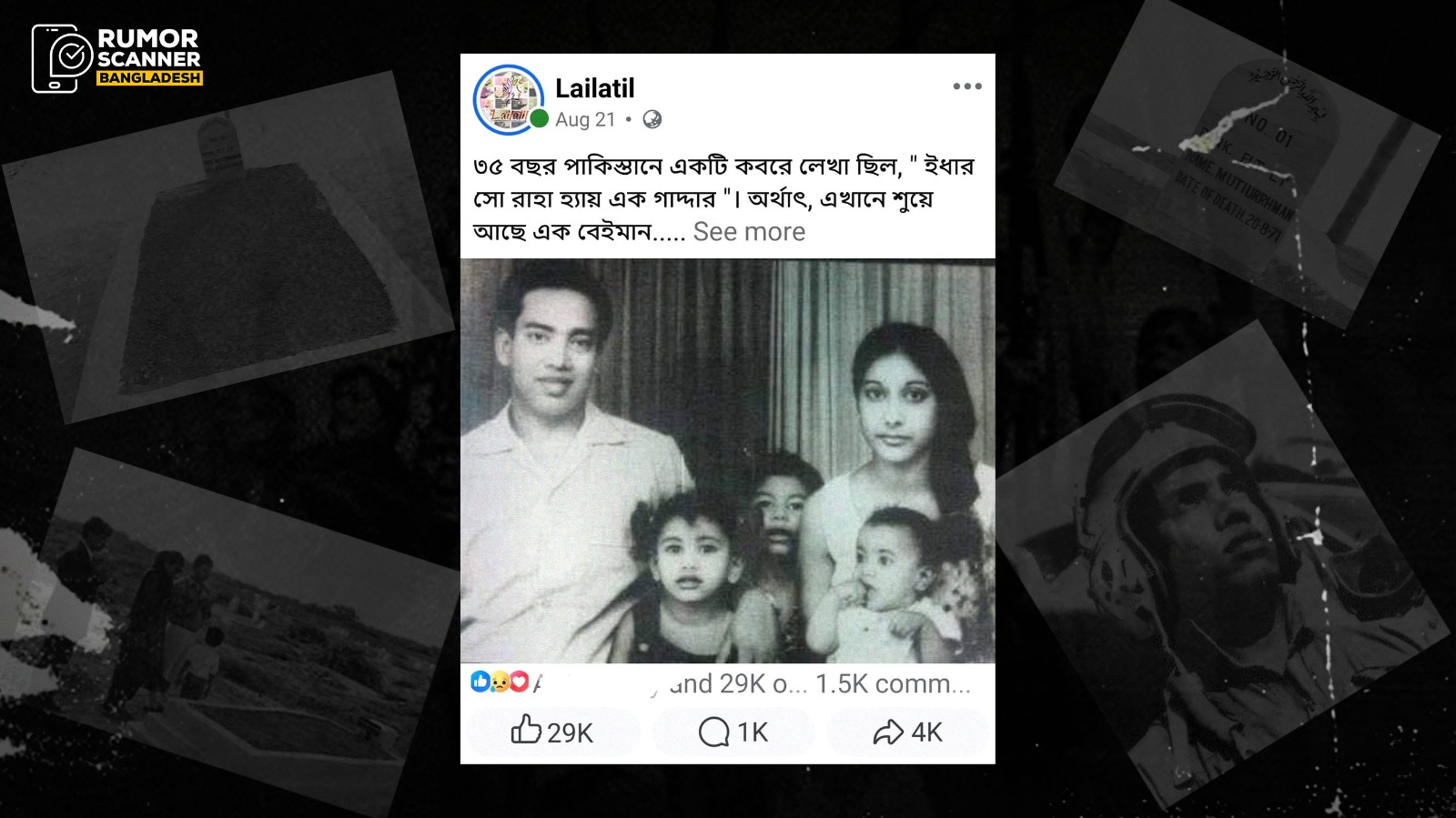
During the 1971 Bangladesh Liberation War, on August 20, Matiur Rahman, a Bengali officer in the Pakistan Air Force, attempted to defect with a fighter jet. During a struggle with Pakistani trainee pilot Rashid Minhas, who was also on board, the plane crashed, killing both. Matiur was buried that same day at the graveyard of Masroor Air Base in Pakistan. After independence, he was honored with the title Bir Shrestha, Bangladesh’s highest gallantry award. On June 24, 2006, his remains were brought back to Bangladesh and interred at the Mirpur Martyred Intellectuals Graveyard the following day.
For many years, a narrative has persisted in media and public discussions that the following phrase was inscribed on Matiur’s grave in Pakistan: “Idhar So Raha Hai Ek Gaddar” (Here lies a traitor).
This claim appeared in a report by the national daily The Daily Star on March 24, 2005. The report stated that he was buried in a graveyard for fourth-class employees and that Pakistani authorities had even dared to disgrace him by hanging his photograph at the main entrance of Masroor Air Base, identifying him as a “Gaddar” (traitor).
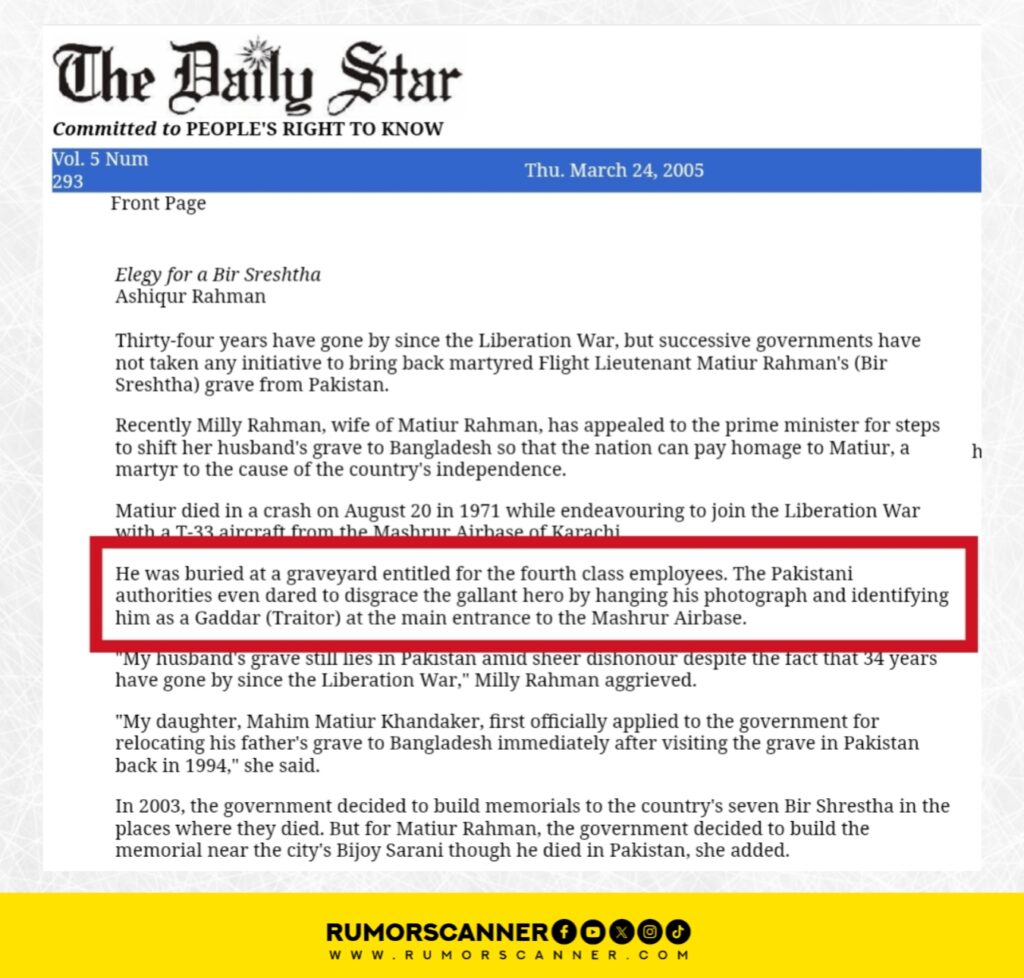
The day after this report was published, a rally and human chain were held at the capital’s Shahbagh, demanding immediate government action to return his body. At a rally organized by the Save the Environment Movement (SEM), Abu Naser Khan, the movement’s convener, made a similar claim, stating that Pakistani authorities had dishonored him by labeling him a “Gaddar” at the airbase entrance.
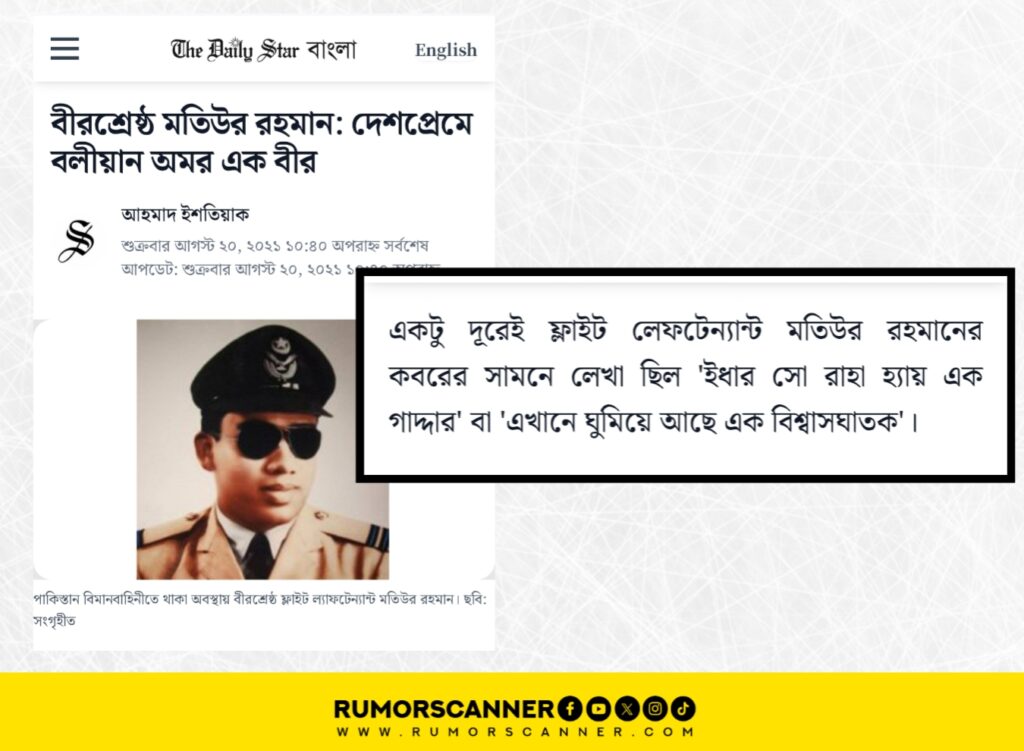
In August 2021, another report by The Daily Star made a slightly different claim, stating that “Idhar So Raha Hai Ek Gaddar” was written in front of Matiur Rahman’s grave.
The same newspaper first claimed in 2005 that his photo was hung at the base entrance with the “traitor” label, but 16 years later, it claimed the text was placed at the grave itself.
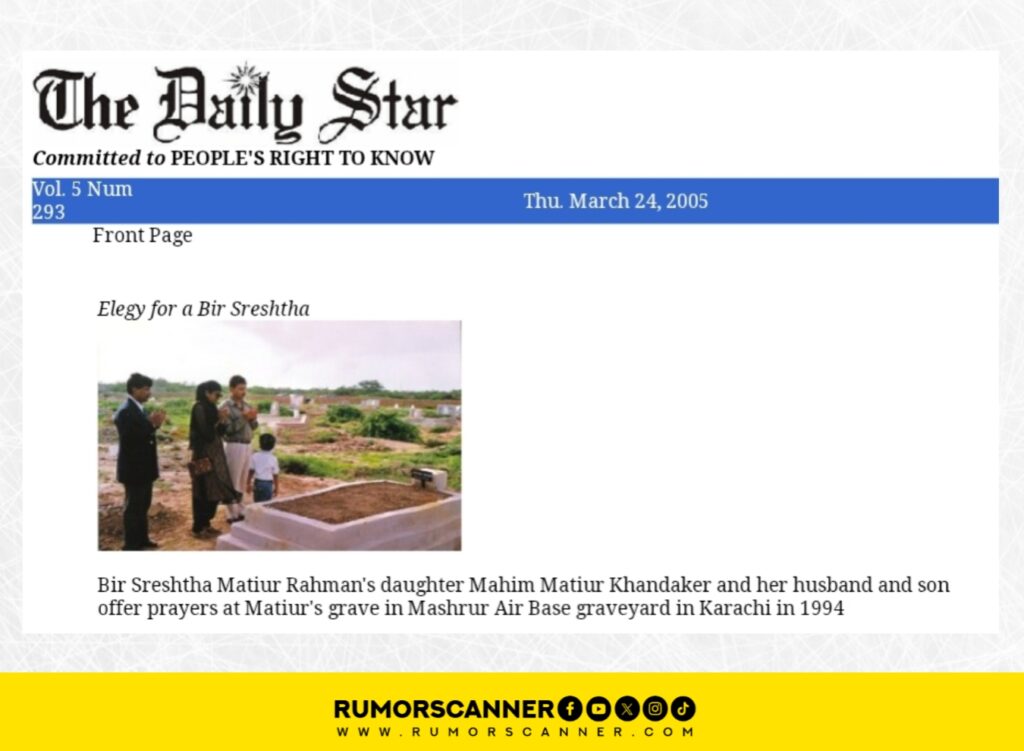
Up to that point, no evidence or photographs had surfaced to support these claims. However, a photograph was included with The Daily Star’s March 24, 2005, report. The caption noted that in 1994, Bir Shrestha Matiur Rahman’s daughter, Mahim Matiur Khandaker, visited his grave at Masroor Air Base with her husband and son. Reviewing the photo shows a small nameplate-like object at the front of the grave. Because the photo was taken from a distance, the exact text on the plaque is illegible, but it is clear that it was too small to accommodate a long sentence like “Idhar So Raha Hai Ek Gaddar.”
On March 21, 2021, a video from a Facebook page named ‘RMS Motivation’ repeated the claim while showing two photos of graves. It asserted that until 2006, the phrase “Idhar So Raha Hai Ek Gaddar” was written in Urdu on Matiur Rahman’s grave. In four and a half years, this video has been viewed nearly 35 million times.
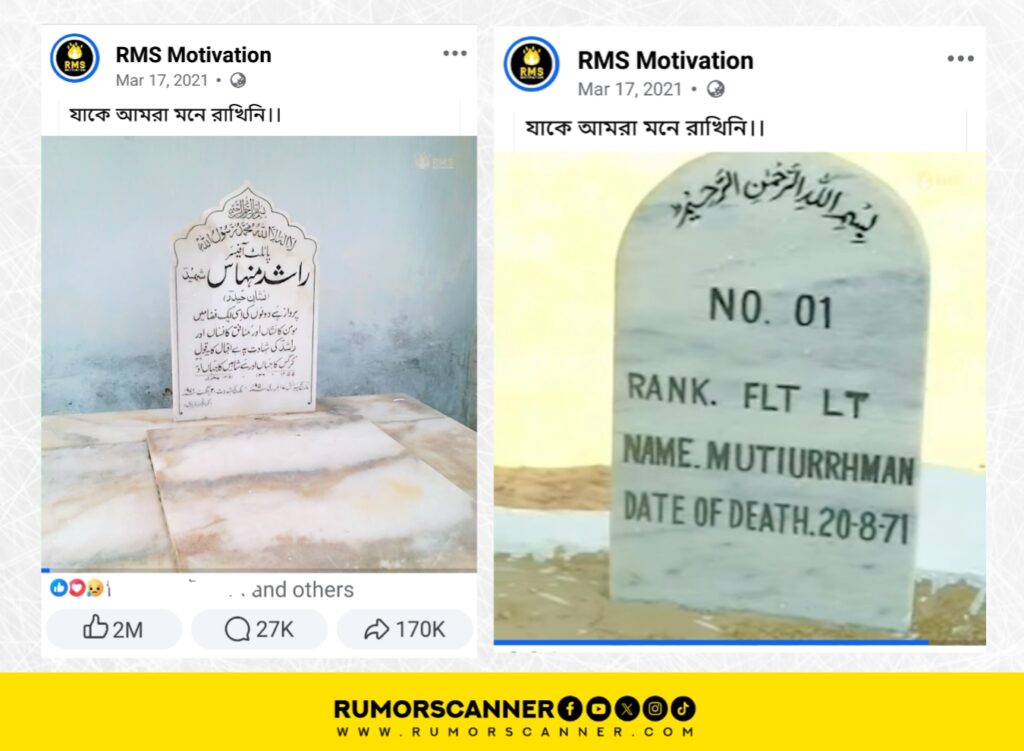
One photo of the grave was found on Wikimedia Commons (and also on Flickr). It is identified as the grave of Rashid Minhas, the pilot who struggled with Matiur. Google Lens translation and Pakistani media sources confirm this is indeed Rashid Minhas’s grave.
.jpg)
The other photo is clearly Matiur’s grave, as indicated by the English text on it. Above the English inscription, “Bismillahir Rahmanir Rahim” is written in Arabic calligraphy.
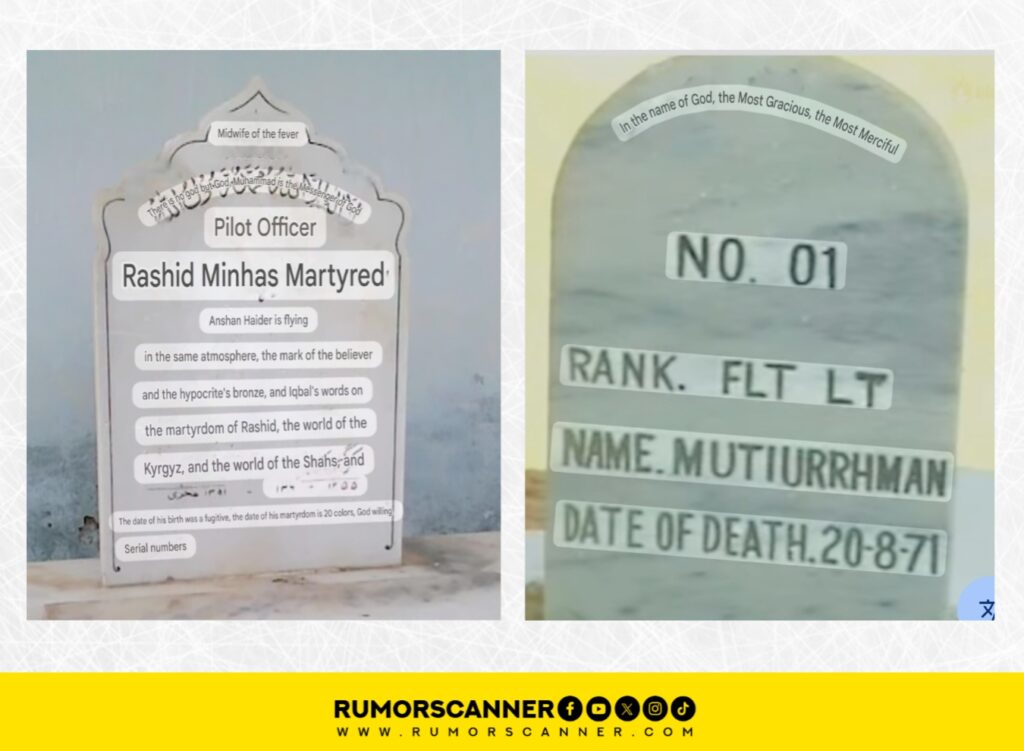
Neither of these photos mentions the word “Traitor” or anything similar.
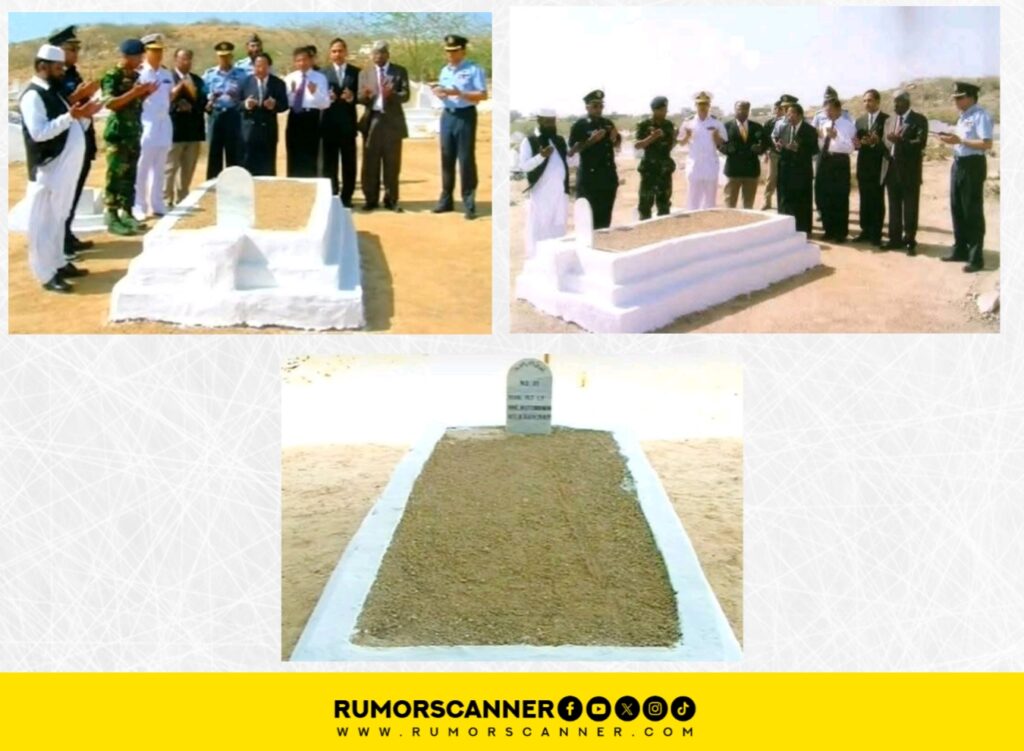
Rumor Scanner found several photos taken in 2006 before Matiur’s remains were exhumed. The design of the nameplate on the grave in these photos differs from the 1994 photo taken during his daughter’s visit, although the rest of the design is consistent. It appears the nameplate was changed after 1994, and the white paint on top of the grave may have been applied during the exhumation ceremony.
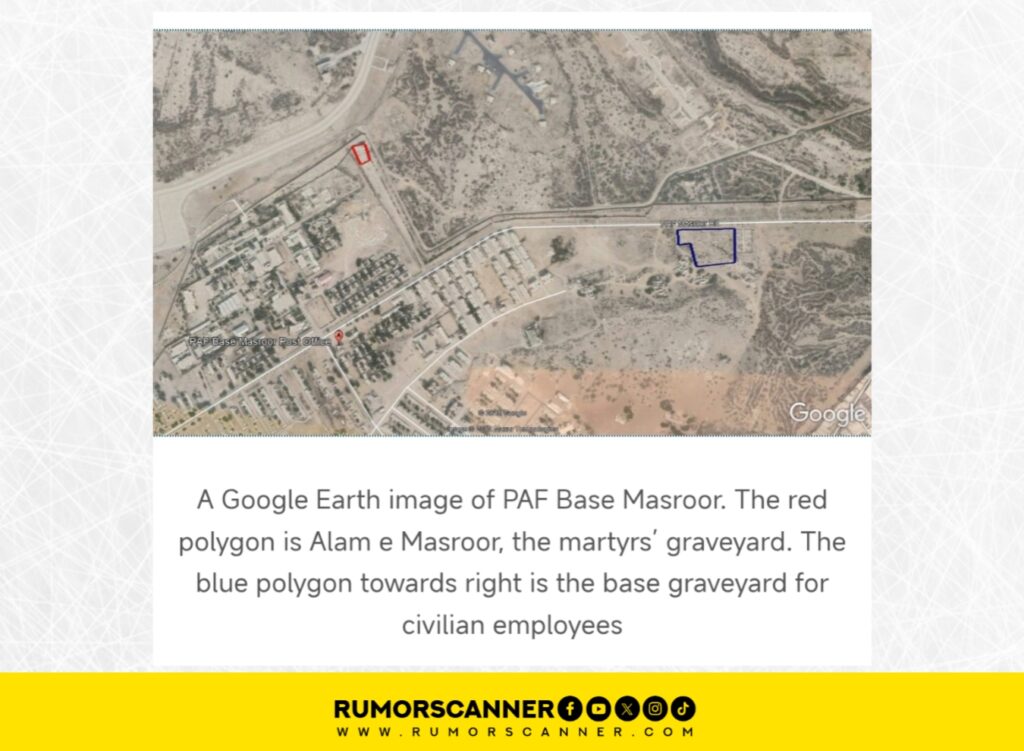
Investigating this widely discussed claim further, Rumor Scanner found a Pakistani author named Imran Saeed, who currently resides in Canada and writes about history, folklore, and military affairs. Several posts on his X account from September 2023 provided information about Matiur Rahman. He also published these details on his blog in August 2019, recounting events from his 2018 visit to Pakistan. During that trip, he visited Masroor Air Base—the largest airbase in Pakistan, located in Karachi’s Mauripur. Imran included photos of the base in his writing, one of which identifies a section of a civilian employee graveyard via Google Earth—the place where Matiur was buried.
Imran visited the cemetery and the site where Matiur died during his trip. Rumor Scanner contacted Imran Saeed, who stated that he had never heard of the claim in question nor seen any photos supporting it. Regarding the 1994 photo of Matiur’s daughter, he said, “The oldest photo I have seen is from the nineties… In that photo, there was no grave plaque, only a small metal plate, likely used to identify the plot number.”
Imran added that the plaque seen during the 2006 exhumation was likely installed by the Pakistan Air Force specifically for the formal handover ceremony. When asked if such words were ever used at the cemetery entrance, he clarified, “There was no wall around the Masroor Air Base cemetery, and there still isn’t. There has never been a gate to enter this graveyard, neither for the whole cemetery nor specifically for Flight Lieutenant Matiur Rahman’s grave”.
Kaiser Tufail, who served as a Pakistan Air Force pilot from 1975 to 2005, wrote a detailed account of the Matiur incident on his blog in 2012, but it did not mention the grave inscription.
Speaking later with Rumor Scanner, Kaiser Tufail said, “I was the Base Commander of Masroor Air Base from 2003 to 2004, and I never heard any such remark (like ‘Here lies a despised traitor’).” He had also served at the base from 1982–85 and 1992–94 and never encountered any derogatory text on the grave or base gates. He noted, “Matiur Rahman’s grave was not specifically marked; it only had a number, so no one knew whose grave it was.”
Milly Rahman, the wife of Matiur Rahman, declined to comment when contacted. Similarly, the Inter-Services Public Relations (ISPR) of Pakistan did not respond to inquiries.
In summary, after analyzing all available information and photographs, no evidence was found to support the long-standing claim that the word “Traitor” or any similar derogatory sentence was inscribed on Bir Shrestha Matiur Rahman’s grave or displayed at the entrance while his body was buried in Pakistan.