

AI-generated image circulated claiming a ‘secret meeting’ between Pinaki-Doval-Krishna Nandi in Delhi
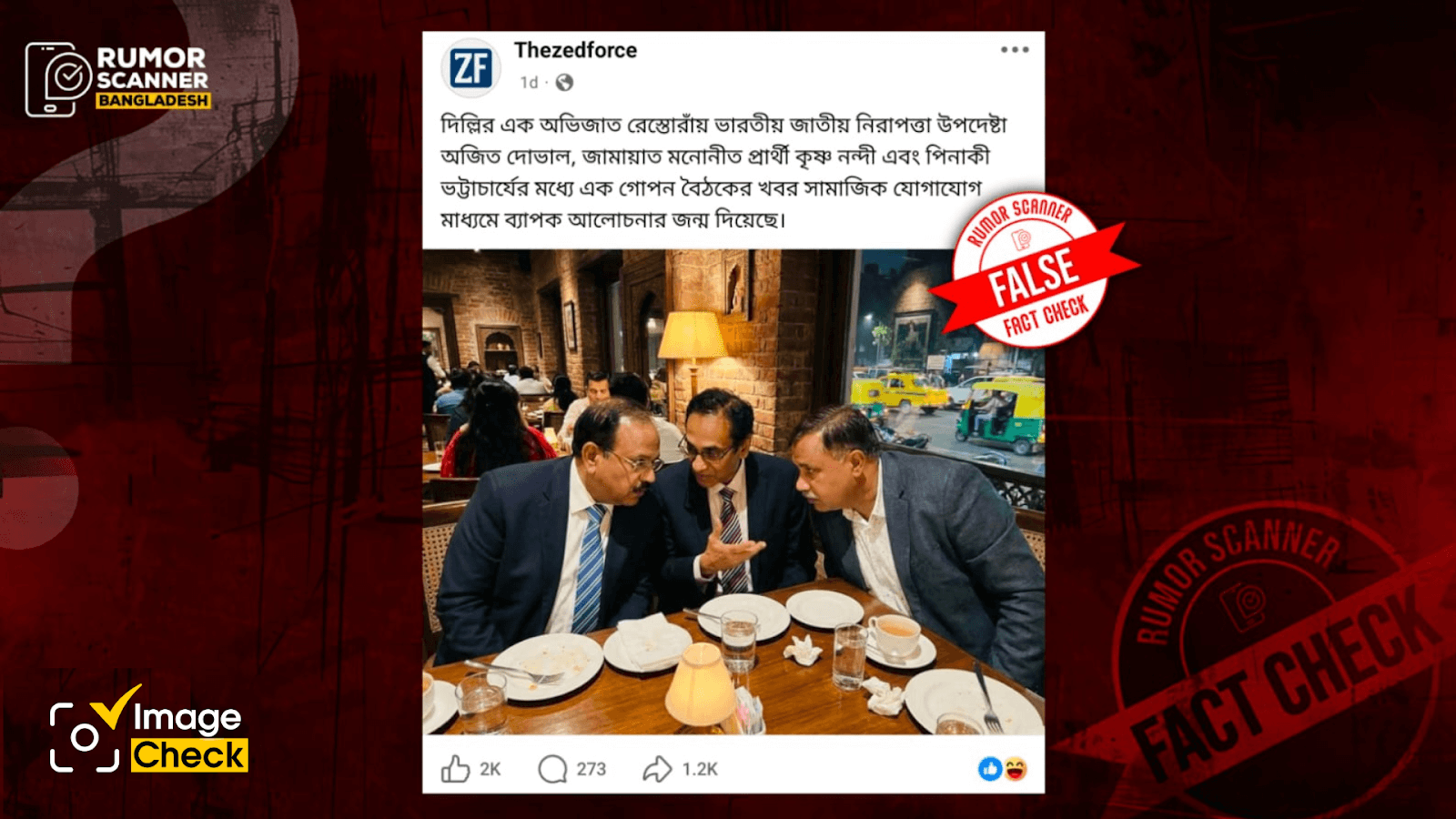
An image has spread on social media claiming that expatriate online activist Pinaki Bhattacharya, India’s National Security Advisor (NSA) Ajit Kumar Doval, and Jamaat-e-Islami candidate for the Khulna-1 seat in the upcoming national parliamentary election, Krishna Nandi, held a secret meeting at an upscale restaurant in Delhi.
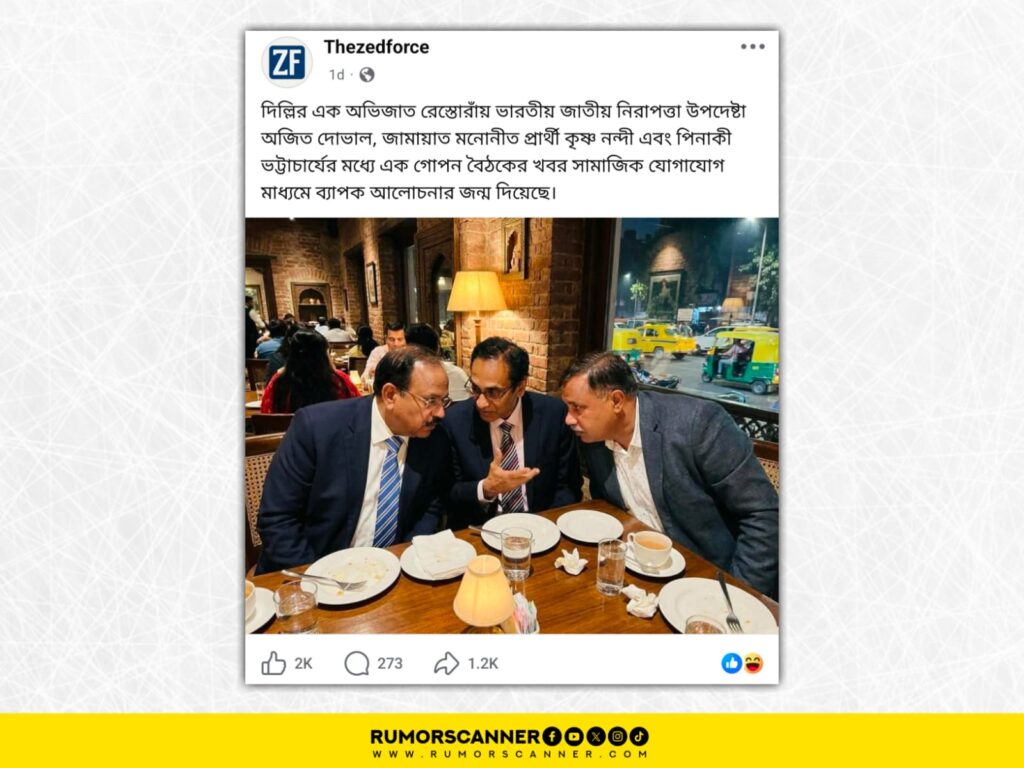
See posts circulated on Facebook with this claim: here, here, here, here, here.
See posts circulated on Instagram with the same claim: here.
Fact-check
The Rumor Scanner team’s investigation reveals that the image circulated claiming a meeting between Pinaki Bhattacharya, Ajit Kumar Doval, and Krishna Nandi is not real. In reality, the image was created using Artificial Intelligence (AI) technology.
In the initial stage of analyzing the image, several AI-related inconsistencies are visible. The lighting inside the restaurant is unusually smooth and overly perfect, indicating artificiality. A distorted reflection is visible in the glass tumbler in front of Pinaki Bhattacharya in the middle of the table. While the rear part of a taxi can be seen outside the window, there is no number plate on it.
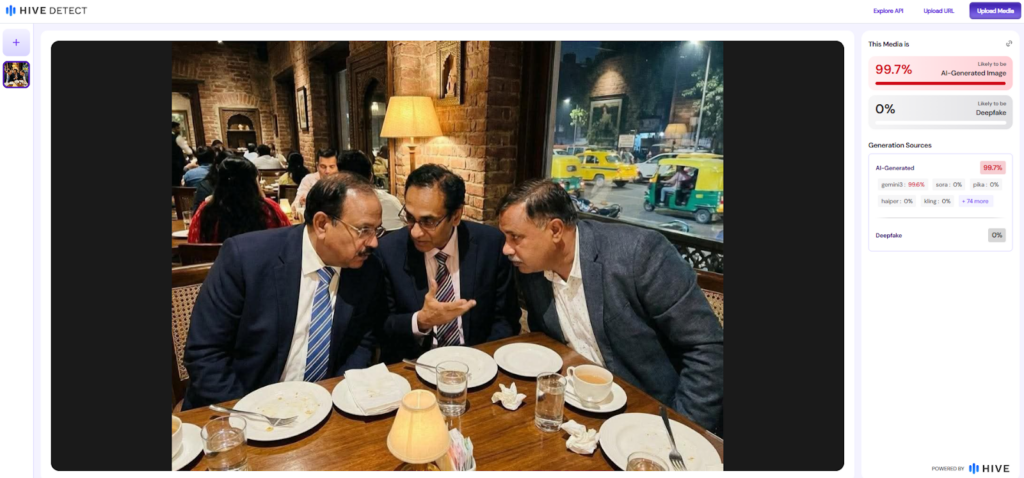
Subsequently, when the image was tested on the AI content detection tool Hive Detect, it showed a more than 99 percent probability of being AI-generated. Another site named Image Whisperer yielded the same result.
Generally, to create such images with AI tools, real photos of the individuals involved must be provided as input. Following this lead, a search was conducted for images of Pinaki Bhattacharya, Ajit Kumar Doval, and Krishna Nandi that might match the viral image.
The investigation found that the attire in Pinaki Bhattacharya’s LinkedIn profile picture, multiple photos from Ajit Kumar Doval’s Instagram posts (1, 2), and Krishna Nandi’s photo published by journalist Zulkarnain Saer matches exactly with the viral image. Consequently, it is evident that these real photos were used as inputs to create the viral image using AI.
In August of this year, the Google Gemini App unveiled an advanced image-generation and editing model named Nano Banana (Nano Banana), which can be used directly from within Gemini. One of the key features of this model is keeping the facial features of a person or pet as consistent as possible during image editing, so that their natural appearance remains consistent even when edited into different outfits, locations, or situations. Additionally, the facility to combine multiple images to create new, higher-quality compositions has been added to it.
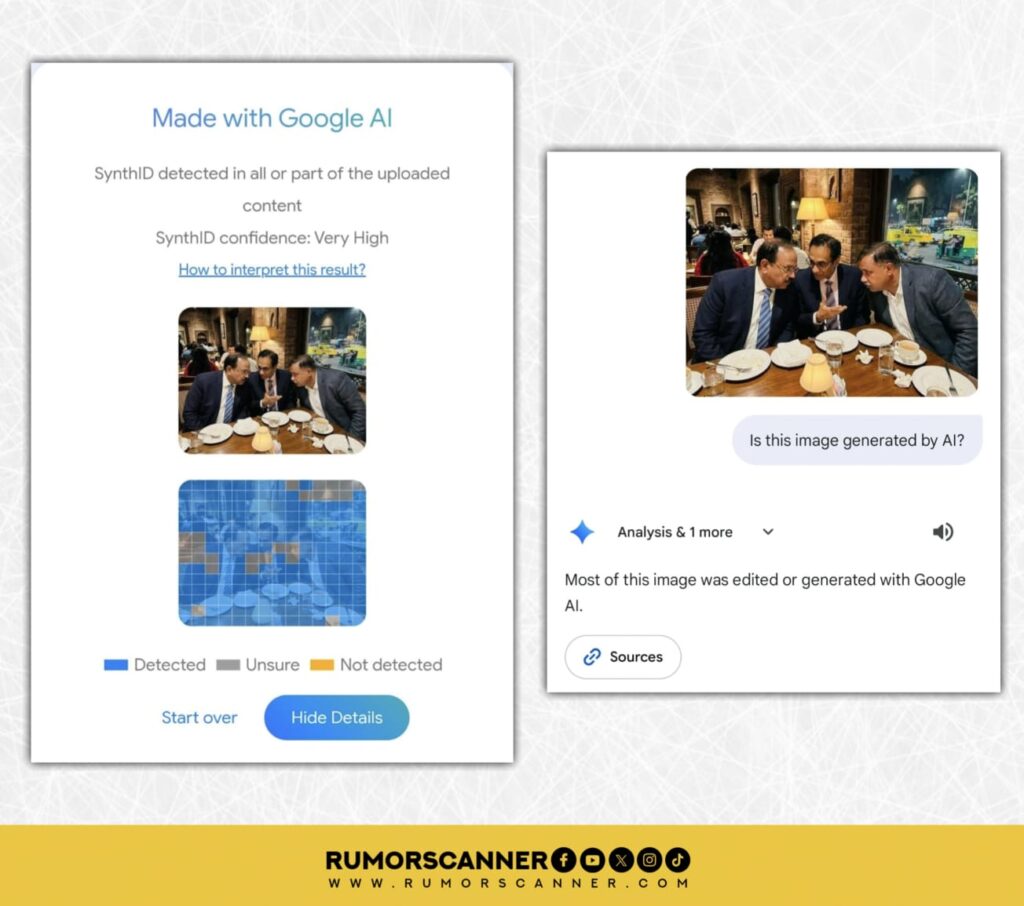
Another Google technology, SynthID (SynthID), adds invisible digital watermarks to AI-generated images, videos, audio, or text, which cannot be seen with the naked eye but can be detected through special technology. Google claims that this watermark is added the moment the content is created and survives editing such as cropping, applying filters, or changing frame rates. If asked whether an image was created or edited by Google AI, uploading the image to Gemini and asking will prompt it to check for the SynthID watermark and report back.
When the viral image was tested in Gemini, Gemini stated that the majority of the image was created using Google’s AI technology. With the assistance of Boom Bangladesh, verifying the image on the specific SynthID portal also confirmed that it is AI-generated content.
Meanwhile, in a Facebook post, Pinaki Bhattacharya also stated that the viral image is not a real photo of him.
Therefore, an AI-generated image of Pinaki Bhattacharya, Ajit Doval, and Krishna Nandi has been circulated as real; which is false.
Sources
- Rumor Scanner’s analysis.
- Hive Detect.
- Image Whisperer.
- SynthID.