

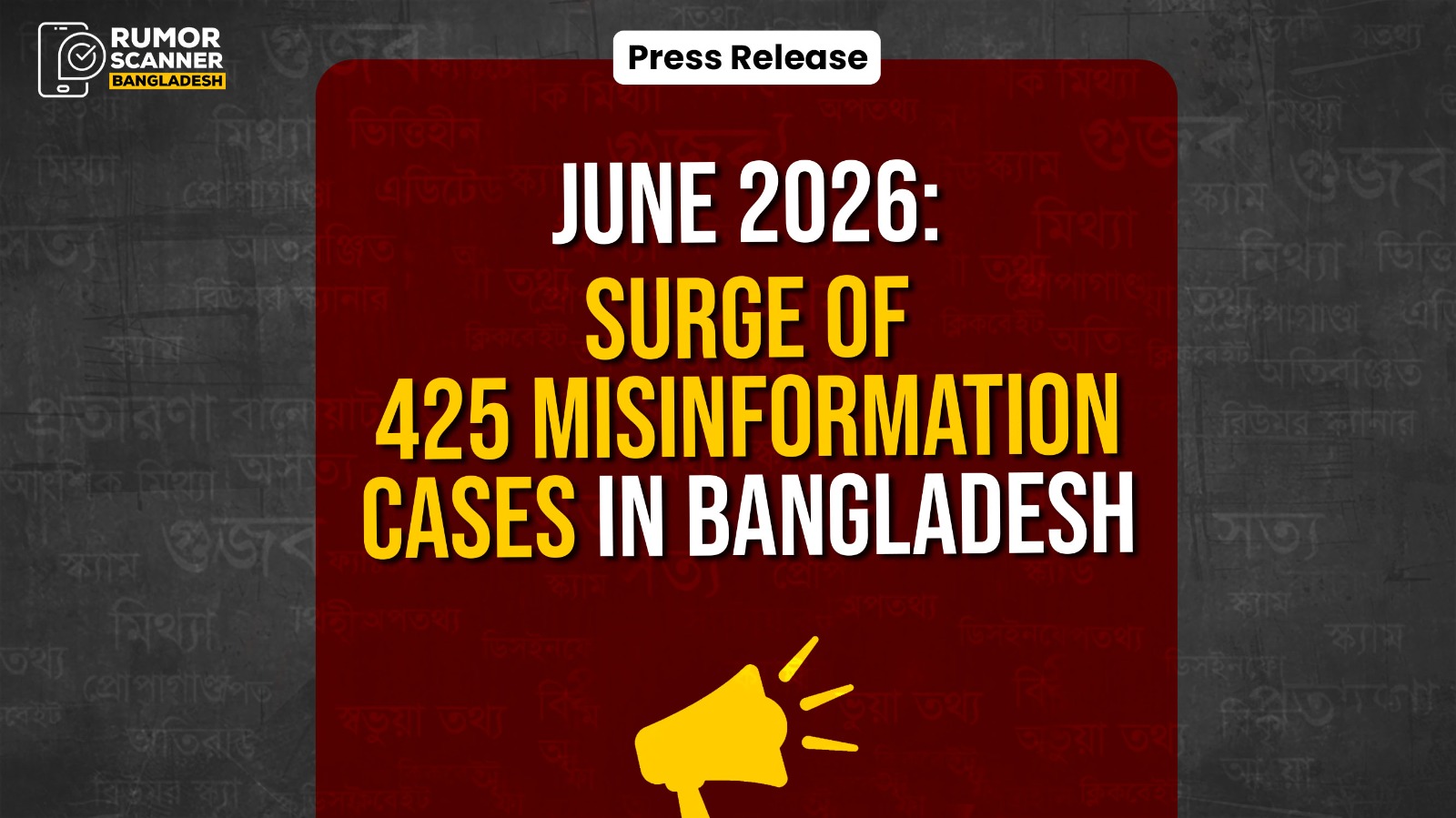
In June of this year, Bangladesh’s fact-checking organization Rumor Scanner identified 425 pieces of misinformation spread on the internet. Fact-checks for these pieces of misinformation were published on Rumor Scanner’s website through 363 reports.
Analysis shows that the highest number of misinformation spread in June was related to political matters (255), which accounts for nearly 60 percent of the total misinformation. Additionally, 76 pieces of misinformation were identified on national issues, 26 on international issues, 39 on sports, 14 on religious matters, 7 on entertainment, and 3 regarding scams last month.
Among these incidents, information-centric misinformation was the highest at 175. Furthermore, there were 170 video-centric and 80 image-centric pieces of misinformation. Among the identified misinformation, 337 incidents were classified as false, 31 as distorted, and 57 as misleading.
Analyzing the identified misinformation, Rumor Scanner found that during this period, 234 pieces of misinformation were propagated involving men, and 101 pieces were identified involving women.
During the same period, the misinformation involving men and women was divided into four categories based on age groups. The analysis reveals that among men, 2 pieces of misinformation were identified regarding children, 72 regarding youths, 73 regarding middle-aged individuals, and 87 regarding the elderly.
Additionally, among women, 13 pieces of misinformation were identified regarding children, 31 regarding youths, 28 regarding middle-aged individuals, and 29 regarding the elderly.
As a platform, Facebook saw the highest spread of misinformation last month, numbering 378. Furthermore, evidence was found of at least 92 pieces of misinformation being propagated on Instagram, 39 on YouTube, 29 on X (formerly Twitter), 65 on TikTok, and 13 on Threads. The country’s mainstream media was not exempt from the list of misinformation propagators. Rumor Scanner observed misinformation being broadcasted across multiple domestic media outlets in 31 incidents. In three instances, Indian media was also found spreading disinformation regarding Bangladesh.
The propagation of communal disinformation centering around Bangladesh and India has been a topic of discussion for several months. In June, Rumor Scanner identified 19 pieces of communal propaganda. Among these, evidence was found that 11 pieces of disinformation were spread from accounts and pages with Bangladeshi identities.
Last month, Rumor Scanner found evidence of 49 pieces of disinformation involving the BNP government, where in nearly 98 percent of cases, the government was presented negatively. During this period, Rumor Scanner observed the propagation of 14 pieces of disinformation involving Tarique Rahman as the Prime Minister, with him being presented negatively in about 79 percent of the cases. In June, Rumor Scanner identified 17 pieces of disinformation regarding the cabinet of the BNP government. Among them, Home Minister Salahuddin Ahmed was the most targeted victim (12 instances, all of which presented him negatively).
In its analysis of June’s fact-checks, Rumor Scanner found that among political parties, 64 pieces of disinformation were identified involving the Bangladesh Nationalist Party (BNP), its affiliate organizations, and its leaders and activists. Among these, 32 pieces of disinformation were spread involving the BNP as a party, which allowed for the creation of a negative perception about the party in nearly 94 percent of the cases. Additionally, 7 pieces of disinformation each were propagated involving Chhatra Dal and Jubo Dal.
In June, 46 pieces of disinformation were propagated involving Bangladesh Jamaat-e-Islami, its affiliate organizations, and its leaders and activists. Among these, 23 pieces of disinformation were spread involving Jamaat as a party. In about 83 percent of these cases, it allowed for the creation of a negative perception about the party. During the same period, 3 pieces of disinformation (all negative) were identified involving the party’s Ameer, Dr. Shafiqur Rahman. Furthermore, 7 pieces of disinformation were propagated involving Chhatra Shibir during this time.
Additionally, in June, Rumor Scanner identified 41 pieces of disinformation involving the National Citizens Party (NCP) and its leaders and activists. Among these, five pieces of disinformation (80 percent negative) were seen being propagated involving the NCP as a party. An equal amount of disinformation (all negative) was identified involving the party’s convener, Nahid Islam.
In June, 131 pieces of disinformation were propagated regarding the Bangladesh Awami League—a party whose activities are banned—its affiliate and fraternal organizations, and its leaders and activists. Among these, 61 pieces of disinformation were spread involving the Awami League as a party, which allowed for the creation of a positive perception toward the party in nearly 85 percent of the cases. Evidence was found of 26 pieces of disinformation (about 88 percent positive) being propagated involving the party’s president, Sheikh Hasina, during this time.
In June, Rumor Scanner observed the propagation of 14 pieces of misinformation regarding the Bangladesh Army, including 6 involving the Chief of Army Staff, General Waker-uz-Zaman. Additionally, Rumor Scanner identified 16 pieces of misinformation involving the Bangladesh Police. During the same period, the propagation of one piece of misinformation involving RAB and six involving the Border Guard Bangladesh was observed.
Analyzing the misinformation identified in June, Rumor Scanner found that 66 pieces of fake content generated by Artificial Intelligence (AI) were identified during this period. Among these, 2 deepfake contents were identified. Contents from sarcasm pages spread as real claims accounted for 51 instances.
In June, there was a propagation of misinformation centering around 9 events or issues in the country. Among these, there were 37 pieces of misinformation regarding the ongoing Football World Cup issue, 34 regarding the Awami League’s founding anniversary issue, 16 regarding the rape issue, 13 surrounding Eid, and 7 surrounding the death of Tofail Ahmed.
The volume of misinformation propagated by using the names, logos, headlines, and fake or counterfeit photocards of media outlets is showing a slight decline. In June, using this method, 40 pieces of misinformation were propagated across 39 incidents, involving 17 domestic and foreign news media organizations.
Issued by
Tanvir Mahatab Abir
Senior Fact Checker,
Rumor Scanner Bangladesh
[email protected]