

- 3,210 misinformation cases identified (Jan–Jun)
- Misinformation dropped in Q2.
- Tarique Rahman: Most targeted individual.
- BNP: Most targeted party.
- National Election: Top disinformation issue.
- Media-spread misinformation increased.
- Rising threats: Communal fake news, satire, and AI content.
In the first six months of 2026, Rumor Scanner identified a staggering 3,210 instances of misinformation in Bangladesh—a sharp 79% surge compared to the same period last year, which saw 1,795 cases. On a brighter note, fake news took a breather in the second quarter, dropping by about 37% compared to the year’s opening months.
This half-yearly wave of misinformation was largely fueled by shifting political landscapes, the parliamentary election, the Football World Cup, and a series of major global events.
When it came to individuals, Prime Minister and Bangladesh Nationalist Party (BNP) Chairman Tarique Rahman bore the brunt of these rumors, emerging as the single most targeted figure. Meanwhile, among political organizations, the BNP found its name dragged into fake news more than any other party.
These insights were uncovered through a detailed analysis of reports published on Rumor Scanner’s website over the last six months.
Facebook, TikTok, and Instagram overrun by a wave of Misinformation
The spread of misinformation across social media reached alarming levels between January and June 2026. During this six-month window, Rumor Scanner tracked a massive wave of fake news across various platforms, flagging 2,822 cases on Facebook, 600 on TikTok, 562 on Instagram, 245 on YouTube, 124 on X (formerly Twitter), and 106 on Threads, alongside at least two cases each on WhatsApp and LinkedIn. Unfortunately, this troubling trend wasn’t confined to social networks; mainstream media outlets also contributed to the noise, leading fact-checkers to debunk 141 misleading claims, photos, and videos published by domestic media outlets. Furthermore, cross-border misinformation was also on the rise, with at least 17 instances of fake news targeting Bangladesh popping up in Indian media during the same timeframe.
Political Disinformation Plummets, But National Issues Take a Hit
Online misinformation saw a significant slowdown as the year progressed, with total cases dropping nearly 37% from 1,974 in the first quarter (January–March) to 1,236 in the second (April–June). This downward trend was mirrored on Facebook and TikTok, which both enjoyed an identical 37% decline in misinformation during the second quarter. On the flip side, several other platforms saw a worrying uptick: misinformation climbed by roughly 13% on YouTube, Instagram, and inside domestic mainstream media, while Threads and X (formerly Twitter) saw increases of 8% and 25%, respectively. Meanwhile, the wave of cross-border disinformation targeting Bangladesh in Indian media offered some relief, scaling back by about 22% during the same period.
A quarter-by-quarter breakdown reveals that during the second quarter, misinformation surrounding national issues climbed by roughly 13%, while religious misinformation saw a modest 3% uptick.
In stark contrast, political disinformation took a massive dive; after dominating the first quarter with 1,528 flagged cases, it plummeted by nearly 49% to just 772 cases in the second. Similarly, international rumors eased up by about 30%, and online scams and fraudulent claims saw a drastic 62% drop.
On the other hand, certain sectors witnessed an absolute explosion in misinformation. Misinformation tied to education skyrocketed by a staggering 275%, while sports-related rumors shot up by nearly 90%, and entertainment and literature saw a lighter 9% increase.
BNP Hit by Most Disinformation, But NCP Bears the Brunt of Online Negativity
During the first six months of 2026, the BNP’s name surfaced more than any other party in the political disinformation sweeping the country. A total of 980 instances of disinformation were identified targeting the party, its leaders, and its various affiliate organizations—with a staggering 95% of these rumors being strictly negative in nature. The smear campaigns were highly focused: about 80% of the rumors portrayed the BNP as a party in a negative light, while roughly 85% specifically targeted its chairman, Tarique Rahman.
Similarly, Bangladesh Jamaat-e-Islami was hit by an intense wave of hostile disinformation, with 702 fake news stories tracked—nearly 88% of which were negative. This streak of negativity stood at roughly 79% when targeting Jamaat as an organization, and soared to about 87% in rumors aimed directly at its Ameer, Dr. Shafiqur Rahman.
On the other hand, while the National Citizen’s Party (NCP) saw a lower total volume of fake news—with 315 instances flagged, roughly 92% of which were negative—it suffered the highest density of hostile content. The smear rate stood at a punishing 84% when targeting the NCP as an organization, and climbed to an overwhelming 92% in rumors aimed directly at its convener, Nahid Islam.
In stark contrast, the narrative flipped completely for the now-banned Bangladesh Awami League. Over the six-month period, 659 instances of disinformation were identified regarding the party, its affiliates, and its members—but a staggering 92% of these were overwhelmingly positive. Looking closer, roughly 87% of the rumors about the party itself and 84% surrounding its president, Sheikh Hasina, were favorable in nature, pointing to a heavily calculated wave of promotional or sympathetic disinformation.
A quarter-by-quarter breakdown reveals a welcome sigh of relief for several political figures in the second quarter, as fake news surrounding the BNP, Tarique Rahman, Jamaat-e-Islami, Dr. Shafiqur Rahman, the NCP, and Nahid Islam all cooled down.
The most dramatic drop involved Tarique Rahman. While 222 rumors targeted him as party chief in the first quarter, that number plummeted to just a single case in the second. This sharp decline directly mirrors his shifting focus, as his involvement in active party politics took a back seat after stepping into his role as Prime Minister (generating 128 prime-ministerial rumors over the six months).
Similarly, disinformation plummeted by roughly 76% for the BNP, 73% for Jamaat, 66% for Shafiqur Rahman, 17% for the NCP, and 20% for Nahid Islam. Meanwhile, the rumor mill surrounding the Awami League held completely steady, with 329 cases flagged in the first quarter and 330 in the second, while disinformation targeting Sheikh Hasina saw a minor dip from 90 to 86 cases.
BNP Government Under Constant Siege by Disinformation
Following its victory in the 13th National Parliamentary Election, the BNP formed a new government on February 17, which quickly found itself under a barrage of disinformation. By the end of June, the newly minted administration had been hit by 305 instances of disinformation, with a staggering 86% of those rumors leaning strictly negative. Prime Minister Tarique Rahman was personally targeted by 128 misleading stories—73% of which painted him in a negative light—while the rumor mill also spun 126 fake stories about his cabinet. Among them, Home Minister Salahuddin Ahmed bore the brunt of the attacks with 35 cases, while 17 other cabinet members were caught in the crosshairs, including Mirza Fakhrul Islam Alamgir (18), A.N.M. Ehsanul Hoque Milan (14), Iqbal Hasan Mahmud Tuku (9), Sheikh Robiul Alam (6), Nurul Haq Nur (6), Amir Khosru Mahmud Chowdhury (5), Dr. Khalilur Rahman (5), Md. Asaduzzaman (4), Shama Obayed (3), Jonaed Saki (3), Ishrak Hossain (3), Fakir Mahbub Anam Swapon (2), Kazi Shah Mofazzal Hossain Kaikobad (2), Bobby Hajjaj (2), and a single case each for Anindya Islam Amit, Aminul Haque, and Zahir Uddin Swapon. The Prime Minister’s advisory panel faced similar heat, with fact-checkers flagging 10 rumors each for Ruhul Kabir Rizvi and Dr. Zahed Ur Rahman, four for Mirza Abbas, and one targeting Special Assistant Sayed Bin Abdullah. Top parliamentary officials weren’t spared either, as Rumor Scanner tracked 12 disinformation aimed at Jatiya Sangsad Speaker Hafiz Uddin Ahmad and one involving Deputy Speaker Kayser Kamal.
Who is in the Crosshairs of Disinformation?
A sector-by-sector breakdown reveals that Prime Minister Tarique Rahman was the single biggest target of political disinformation over the last six months, with 128 rumors aimed at his role as prime minister and 223 targeting him as party chief; he was followed closely in this category by Sheikh Hasina and Dr. Shafiqur Rahman. When it came to broader national issues, Dr. Muhammad Yunus topped the rumor mill, followed by former advisor Syeda Rizwana Hasan and President Mohammed Shahabuddin.
Gender-related disinformation most frequently centered around Sheikh Hasina, with Tarique Rahman’s daughter Zaima Rahman and Dhaka University lecturer Shehreen Amin Bhuiyan (Monami) also heavily targeted. In the realm of student politics, Ducsu leader Fatima Tasnim Zuma, Ducsu VP Shadik Kayem, and Dhaka University Jatiyatabadi Chhatra Dal leader Abidul Islam Khan bore the brunt of online rumors, while the Bangladesh Army emerged as the primary target for institutional disinformation, followed by the Bangladesh Police and the Border Guard Bangladesh (BGB).
The storm also hit the sports and entertainment worlds, where cricket star Mustafizur Rahman faced the highest volume of misinformation, followed by BCB President Tamim Iqbal, with Shakib Al Hasan, Mashrafe Mortaza, and former BCB chief Aminul Islam Bulbul tracking closely behind with nearly equal shares of misinformation. Meanwhile, in entertainment, the late content creator Kareena Kaiser was the most targeted figure, followed by singer Asif Akbar and content creator Towhid Afridi.
From Army Chief to IGP: Top Security Bosses in the Crosshairs of Disinformation
Over the first six months of the year, Rumor Scanner uncovered 195 instances of disinformation targeting Bangladesh’s armed forces and law enforcement agencies—a sharp 71% surge compared to the same period last year. However, the tide of disinformation did slow down as the year progressed, with cases dropping about 31% from 134 in the first quarter to 61 in the second.
The Bangladesh Army was hit hardest, with 96 disinformation flagged over the six-month period, marking a 30% increase from the 74 cases tracked during the same timeframe last year. Even the top brass wasn’t spared, as fact-checkers debunked 21 disinformation aimed directly at the current Chief of Army Staff, General Waker-Uz-Zaman.
Meanwhile, the Bangladesh Police faced an absolute explosion of disinformation, with 86 cases identified—a staggering 187% spike compared to the first half of last year. This wave of disinformation reached the very top of law enforcement leadership, with one rumor each tracked targeting Inspector General of Police (IGP) Ali Hossain Fakir, former IGP Baharul Alam, current DMP Commissioner Mosleh Uddin Ahmed, and former DMP Commissioner Sheikh Md. Sazzat Ali.
Beyond the army and police, other security sectors also caught the attention of the rumor mill. Rumor Scanner flagged seven instances of disinformation involving the Border Guard Bangladesh (BGB), four targeting the Rapid Action Battalion (RAB), and one case each involving the Bangladesh Air Force and the Bangladesh Navy.
Elections at Home, Wars Abroad: What’s Driving the Surge in Misinformation
Between January and June 2026, the surge of online misinformation proved to be highly multifaceted and issue-driven. During this period, Rumor Scanner tracked 1,467 instances of misinformation across 42 major national and international topics, with mainstream media outlets falling for the trap in 24 of those instances. This data highlights a growing and alarming trend: misinformation is now spreading in a highly organized, rapid manner around major breaking events, primarily targeting sensitive, political, and global affairs.
On the domestic front, the 13th National Parliamentary Election was the biggest magnet for disinformation, triggering a whopping 774 instances of disinformation. Additionally, a steady stream of rumors kept fact-checkers busy across a wide range of topics, including the national referendum (38), the energy crisis (37), the Awami League’s founding anniversary (34), a measles outbreak (33), Eid celebrations (29), various rape cases (25), the Dipu Das murder case (18), the detention of Bibi Sawda (17), exam leaks (16), the Ramisa murder case (16), and uranium-related claims at the Rooppur Nuclear Power Plant (14). Rumors also consistently flared up around clashes between Inqilab Mancha and the police (12), Mustafizur Rahman being dropped from the IPL (12), claims that Dr. Shafiqur Rahman’s X account was hacked (11), Ramadan (10), the assault on Osman Hadi (9), rumors of Khaleda Zia’s passing (9), the JUCSU elections (8), Language Martyrs’ Day (8), Pahela Baishakh (8), the arrest of Faisal Karim Masud (7), gas shortages (6), Independence Day (5), and the Hajj pilgrimage (4).
Internationally, the Iran-Israel conflict sparked the highest volume of misinformation with 180 cases—outpacing any other single topic. Beyond that, the ongoing 2026 FIFA World Cup (37), India’s state assembly elections (45), the Epstein files (13), the Pakistan-Afghanistan conflict (4), US military actions in Venezuela (3), and the T20 World Cup (4) also drew a fair share of misinformation.
Ultimately, the first half of 2026 clearly demonstrates that wars, international conflicts, political campaigns, national crises, religious festivals, public health issues, elections, and high-profile crimes remain the primary catalysts for misinformation. This period underscores a persistent reality: the more current and high-stakes an event is, the faster the rumor mill spins to exploit it.
AI, Satire, and Deepfakes: The Changing Face of Disinformation
An analysis of disinformation trends over the first two quarters of this year highlights several critical shifts. Disinformation is no longer confined to basic rumors or false text claims; instead, there has been a major transformation in both the nature of the content and the sophisticated tactics used to spread it.
Leading the charge is artificial intelligence (AI)-generated disinformation, with Rumor Scanner flagging a whopping 504 instances between January and June. Fabricated images, altered videos, and synthetic text have all been deployed to craft highly convincing false narratives. As this AI-generated content becomes increasingly lifelike, it has regularly duped not only everyday internet users but mainstream media outlets as well.
Another alarming trend is the growing habit of taking content from parody or satirical pages and presenting it as hard fact. Over the six-month period, 374 such instances were identified. In these cases, lighthearted or sarcastic posts were ripped out of context and circulated as true stories. This dynamic amplified confusion exponentially, occasionally even tricking high-profile public figures and officials into reacting to fake news as if it were authentic.
Additionally, fact-checkers tracked 38 misleading pieces of media built entirely on deepfake technology. While their total numbers were relatively low, their impact was massive. Because deepfakes seamlessly clone the real faces and voices of public figures, they are incredibly difficult for the average user to spot, allowing them to gain rapid credibility and cause serious reputational damage.
Misinformation in Mainstream Media
During the first six months of 2026, a total of 90 instances of misinformation were documented across the country’s mainstream media outlets. This year, that figure surged by approximately 57%, climbing to 141 cases. A review of the fact-checks published by Rumor Scanner over the last six months reveals that Inqilab topped the list of media organizations responsible for spreading the highest volume of misinformation, followed by Ittefaq in second place, with Jugantor and BD24Report tying for third.
Disinformation Campaign Against Bangladesh From Indian Sources Continues
The coordinated push to spread disinformation about Bangladesh from Indian mainstream media outlets and India-based social media handles shows no signs of slowing down. A fresh evaluation by Rumor Scanner over the first six months of this year reveals that the alarming trend remains fully intact.
Between January and June, a staggering 56 different Indian media organizations were caught broadcasting or publishing disinformation across 17 distinct events involving Bangladesh. Topping the list of perpetrators were Aaj Tak Bangla and Republic World, which were flagged for driving the highest volume of disinformation, each spearheading three separate instances of disinformation.
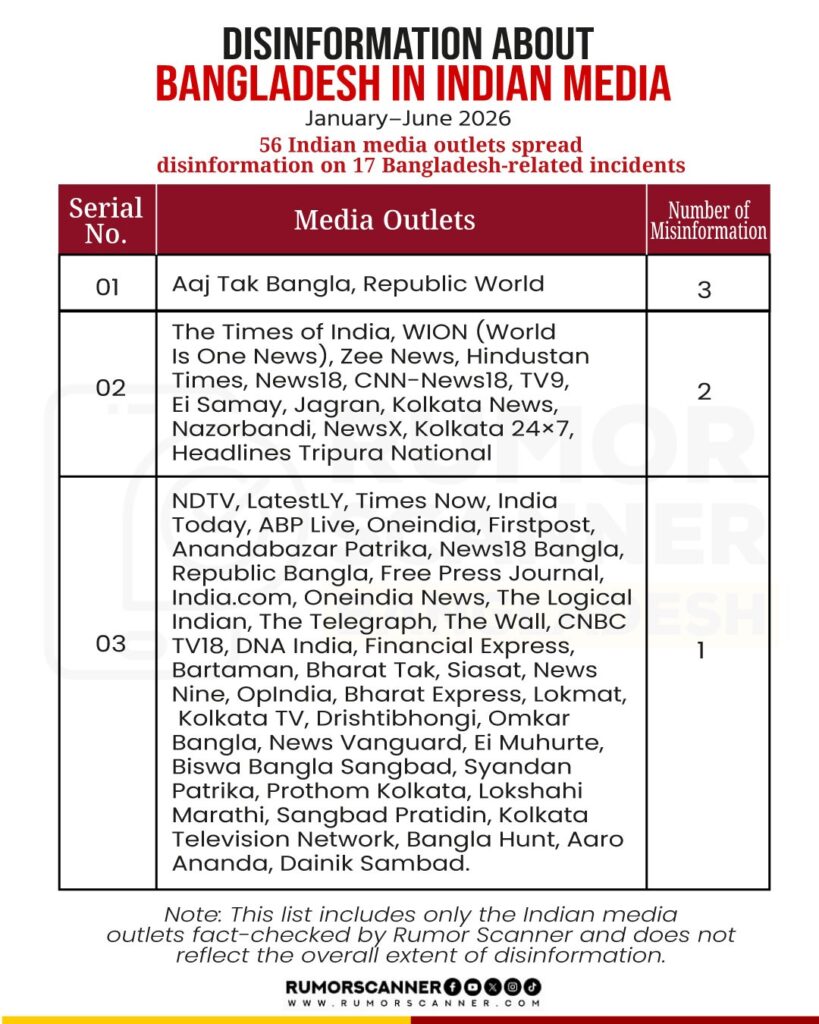
Additionally, explicit evidence was found in at least 51 separate instances where India-based social media accounts and pages actively engineered and amplified disinformation targeting Bangladesh. Alongside general fake news, the rise of communally charged and sectarian disinformation has also drawn intense scrutiny in recent years.
Over the first six months of this year, Rumor Scanner flagged 105 instances of communal propaganda. Strikingly, the data reveals a near-even split in the source of these narratives: 53 of these cases were traced back to Bangladeshi sources, while the remaining 52 were driven by accounts and pages identifying as Indian.
Hundreds of Disinformation Cases Spread by Mimicking Credible News Outlets
Hijacking the identity of credible news organizations has evolved into a highly calculated strategy for spreading disinformation. Over the first quarter, the trend of manufacturing fake digital photocards—using the exact names and official logos of established media houses—surged at an alarming rate. Fact-checkers flagged 720 such incidents during this period, which were weaponized to blast out a total of 739 fake stories.
Domestic media houses bore the absolute brunt of this tactic. Out of 70 distinct news brands cloned by bad actors, 62 were Bangladeshi outlets, whereas international media organizations accounted for just eight.
Among the targeted outlets, the daily Amar Desh topped the list with its branding forged in 99 separate instances. Broadcast giant Jamuna TV followed closely behind with 96 cases, while the daily Kaler Kantho was targeted 76 times. Additionally, the networks of RTV (43) and Channel 24 (39) were also heavily exploited to give disinformation an air of legitimacy.
Working Method
These statistics have been compiled based on fact-checking reports published on the Rumor Scanner website from January to June 2026. To achieve this, data and evidence from every report published during this period were systematically gathered and logged into a dedicated database. This data was subsequently analyzed to identify emerging trends, patterns, and distinct characteristics. In addition to a comparative analysis between the first and second quarters of the current year, the data was also benchmarked against the figures from January to June 2026. The final insights derived from this analysis have been presented through a combination of infographics and descriptive narratives.
When analyzing misinformation targeting political parties, political figures, and various government officials, a two-tiered classification system—Positive and Negative—was employed. If a piece of fake news was engineered to artificially elevate or positively portray the image of the concerned individual or party, it was categorized as positive. Conversely, if the misinformation aimed to tarnish their reputation, spark controversy, or foster a negative public perception, it was classified as negative. In determining these classifications, careful consideration was given to the core content of the misinformation, its timing, the contemporary political backdrop, and the surrounding circumstances.